


Listen To This Post
Amid Strains in Ties with US, Putin Two’s India Visit
New Delhi: Prime Minister Narendra Modi will host a private dinner for Russian President Vladimir Putin on Thursday evening, hours after the Russian leader arrives in the national capital on a nearly 28-hour visit aimed at reinforcing the strategic, defence, energy and economic partnership between the two countries. The visit assumes added significance against the backdrop of a sharp downturn in India–US relations, following Washington’s imposition of steep tariffs and sanctions-linked pressures on New Delhi’s energy trade with Moscow.
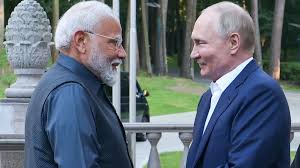
President Putin is expected to land in New Delhi around 4.30 pm on Thursday, and Prime Minister Modi’s private dinner invitation is being seen as a diplomatic gesture of warmth and continuity in bilateral ties. The move mirrors Putin’s own gesture last year, when he hosted Modi at a private dinner during the Indian Prime Minister’s visit to Moscow in July 2024.
Ceremonial Welcome, Rajghat Visit and 23rd Annual Summit
On Friday morning, Putin will be accorded a ceremonial welcome followed by a visit to Rajghat to pay tribute to Mahatma Gandhi. Thereafter, he will proceed to Hyderabad House for the 23rd India–Russia Annual Summit, where the two leaders will hold wide-ranging talks.
Prime Minister Modi will also host a working lunch for the Russian President and his delegation. Following the summit, Putin will launch the India channel of the Russian state-owned broadcaster, underlining Moscow’s attempt to expand its media and outreach footprint in South Asia. The Russian leader will later attend a state banquet hosted in his honour by President Droupadi Murmu at Rashtrapati Bhavan.
Putin is scheduled to leave India at around 9.30 pm on Friday, concluding his high-profile diplomatic visit.
Defence, Energy and Trade to Dominate Talks
The summit discussions are expected to focus on three critical pillars—defence cooperation, energy security, and trade rebalancing, officials familiar with the preparations said.
A key concern for New Delhi will be India’s ballooning trade deficit with Russia, mainly driven by large-scale imports of discounted Russian crude oil since the Ukraine war. Currently, India’s annual imports from Russia stand at nearly USD 65 billion, while exports to Russia linger around USD 5 billion, creating profound trade asymmetry.
India is expected to push for greater market access for its exports, particularly in pharmaceuticals, agriculture, food processing, textiles and consumer goods. Both sides are also likely to review cooperation in the fertiliser sector, with Russia currently supplying three to four million tonnes of fertilisers to India annually.
Another significant item on the agenda will be the proposed India–Eurasian Economic Union Free Trade Agreement, which New Delhi sees as a key route to expanding trade with Russia and Central Asia.
Impact of US Sanctions and Ukraine War
The summit is taking place at a sensitive geopolitical moment, as India–US relations have entered perhaps their most strained phase in two decades. Washington recently imposed a 50 per cent tariff on Indian goods, including 25 per cent penalty-linked levies over India’s continued purchase of Russian crude oil.
The impact of US sanctions on India’s energy security is expected to be discussed in detail. On Tuesday, Kremlin spokesperson Dmitry Peskov acknowledged that India’s crude purchases from Russia could decline “for a brief period” due to Western sanctions but asserted that Moscow was actively exploring ways to stabilise and enhance supplies.
Putin is also expected to brief Modi on the latest US-led diplomatic initiatives to end the Ukraine conflict. India has consistently maintained that dialogue and diplomacy are the only viable path to ending the war, while carefully balancing ties with both Moscow and the West.
Defence Ministers’ Talks, S-400 and Su-57 on Table
Even ahead of the leaders’ summit, the focus on defence cooperation will be sharp. The defence ministers of India and Russia will hold wide-ranging talks on Thursday, with discussions likely to centre on additional procurement of S-400 air defence missile systems, along with other critical military hardware.
Senior defence officials said that the performance of the S-400 systems during Operation Sindoor had underlined their operational value for India’s air defence architecture. India had signed a USD 5 billion deal in October 2018 for five units of the S-400 systems, despite strong warnings from the US that the purchase could trigger sanctions under the CAATSA law.
Kremlin spokesperson Peskov has also indicated that Russia may offer its fifth-generation Su-57 fighter jets to India. India is currently in the process of selecting a fifth-generation fighter platform, with contenders including Dassault Rafale, Lockheed Martin’s F-21, Boeing’s F/A-18 and the Eurofighter Typhoon, making the Russian offer strategically significant.
Energy Discounts and Small Modular Reactors
Energy cooperation is set to feature prominently, with Russia reportedly offering additional discounts on crude oil supplies, following a recent dip in India’s purchases amid fresh US sanctions on two Russian oil producers.
Beyond hydrocarbons, the two sides are also expected to explore cooperation in small modular nuclear reactors (SMRs), an emerging area in clean energy where Russia has advanced technological capabilities and India is looking to diversify its nuclear power mix.
Labour Mobility and New Trade Agreements
Several agreements are expected to be signed after the summit, including a pact to facilitate the movement of Indian workers to Russia, particularly in construction, shipbuilding and industrial sectors. Another agreement will focus on logistical support under the expanding defence cooperation framework.
A Time-Tested Partnership Under Global Pressure
India and Russia have maintained an institutionalised annual summit mechanism since 2000, with 22 summits held so far alternately in both countries. President Putin last visited New Delhi in 2021, while Modi’s July 2024 visit to Moscow reaffirmed political continuity despite global turbulence.
Russia continues to be described by Indian officials as a “time-tested partner” and a key pillar of India’s strategic autonomy, especially amid rapid changes in global power alignments.
As the Modi–Putin summit unfolds under intense international scrutiny, the outcome is expected to reshape not only India–Russia ties but also New Delhi’s broader positioning in an increasingly polarised global order.