






Listen To This Post
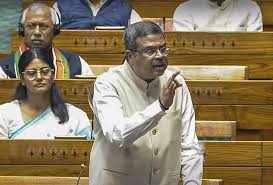
New Delhi: Amid opposition concerns that the Viksit Bharat Shiksha Adhishthan Bill, 2025 would centralise control over higher education, Union Education Minister Dharmendra Pradhan asserted that states will retain the powers they currently exercise, and the proposed framework would promote flexibility and innovation. The Lok Sabha passed a resolution to refer the Bill to a Joint Parliamentary Committee (JPC), following objections raised by Opposition members. Pradhan himself moved the motion to constitute the panel.
JPC to Examine Concerns
The 31-member JPC, comprising 21 Lok Sabha and 10 Rajya Sabha MPs, will examine the proposed legislation and submit its report by the last day of the first part of the Budget Session, 2026. “There is no threat to institutional autonomy. If the Opposition has concerns or misconceptions, the JPC can address them. The powers with the states will remain exactly as they are today,” Pradhan said. The government had earlier indicated its willingness to send the Bill to a joint panel when it was introduced on December 15, acknowledging resistance from Opposition parties.
New Apex Body for Higher Education
The Bill proposes the creation of the Viksit Bharat Shiksha Adhishthan as an apex authority for higher education regulation, supported by three specialised councils:
-
Viksit Bharat Shiksha Viniyaman Parishad (Regulatory Council),
-
Viksit Bharat Shiksha Gunvatta Parishad (Accreditation Council), and
-
Viksit Bharat Shiksha Manak Parishad (Standards Council).
It also seeks to repeal three existing laws:
-
University Grants Commission (UGC) Act, 1956,
-
All India Council for Technical Education (AICTE) Act, 1987, and
-
National Council for Teacher Education (NCTE) Act, 1993.
Once enacted, all higher education institutions currently regulated by the UGC, AICTE and NCTE would come under the new Adhishthan for standard-setting, regulation and accreditation.
Funding to Remain with the Centre
Officials clarified that the funding mechanism for higher education institutions will remain under the Education Ministry, in line with the National Education Policy (NEP) 2020, which envisages a separation between funding and regulatory functions.
At present, grants to central universities are routed through the UGC, while Institutes of National Importance receive funds directly from the Centre. “New mechanisms for grant disbursal will be similar to or better than the existing system,” officials said, adding that performance feedback from the Regulatory Council would play a key role in determining fund allocation. The Bill, the government maintains, aims to modernise higher education governance while aligning it with the long-term vision of Viksit Bharat 2047—a claim that the parliamentary panel will closely scrutinise.