


Listen To This Post
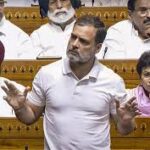
New Delhi: The Lok Sabha on Thursday passed the Viksit Bharat Guarantee for Rozgar and Ajeevika Mission (Gramin) (VB-G RAM G) Bill, 2025, replacing the two-decade-old MGNREGA, amid fierce Opposition protests, slogan-shouting and tearing up of copies of the Bill inside the House. The proceedings were adjourned for the day soon after the Bill’s passage, with Friday being the last sitting of the Winter Session.
The Bill, piloted by Rural Development Minister Shivraj Singh Chouhan, provides a statutory guarantee of 125 days of wage employment per rural household, up from the existing 100 days under MGNREGA. Chouhan, replying to an eight-hour debate, asserted that the Modi government was upholding Mahatma Gandhi’s ideals, not erasing them.
However, Opposition MPs strongly disagreed, accusing the government of diluting the Right to Work and removing Mahatma Gandhi’s name from one of India’s most significant social welfare laws.
Opposition Protests Inside and Outside Parliament
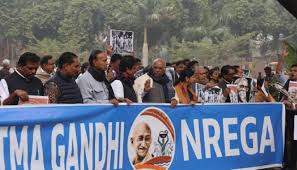
Even as the Bill was being debated, Congress and the INDIA bloc MPs staged a protest march inside the Parliament complex, starting from the Gandhi statue and ending at Makar Dwar. Holding placards and raising slogans such as “Mahatma Gandhi ka apman nahi sahenge”, the protesters said the renaming amounted to an ideological assault on Gandhi’s legacy and constitutional welfare guarantees.
Congress Parliamentary Party chairperson Sonia Gandhi, Congress president Mallikarjun Kharge, and senior leaders of the INDIA bloc led the protest.
“The Modi government has not only insulted the Father of the Nation but also crushed the Right to Work that transformed rural India. Against this authoritarianism, we will fight from Parliament to the streets,” Kharge said.
Priyanka Gandhi: ‘This Will Finish MGNREGA’
Congress general secretary Priyanka Gandhi Vadra vowed a full-scale political fight against the legislation, asserting that the Opposition stood united.
“This Bill will finish off MGNREGA completely. The claim of increasing workdays from 100 to 125 is a deceit. Once the financial burden shifts to states, the scheme will collapse—especially in poorer states that need it the most,” she said.
Calling the move anti-poor and anti-labour, Priyanka warned that rural employment guarantees would be slowly dismantled under the new framework.
House Adjourned, Pollution Debate Next
Following the uproar, Speaker Om Birla adjourned the House for the day. A separate discussion on air pollution in Delhi-NCR is scheduled for Friday, with Priyanka Gandhi expected to initiate the debate.
Implications of the G RAM G Bill’s Passage
1. A Major Shift in Rural Welfare Architecture
The Bill marks the most significant restructuring of rural employment policy since 2005, shifting from a rights-based framework under MGNREGA to a centrally designed mission aligned with Viksit Bharat 2047. Critics fear this weakens enforceable entitlements.
2. Centre–State Financial Tensions Ahead
Opposition concerns about greater financial responsibility on states could become a flashpoint, particularly for fiscally stressed states heavily dependent on rural employment schemes.
3. Gandhi vs Governance Narrative Intensifies
The removal of Mahatma Gandhi’s name has transformed a policy debate into a symbolic and ideological battle, giving the Opposition a potent rallying point ahead of upcoming elections.
4. Legal and Political Challenges Likely
Given the scale of opposition, the Bill is expected to face judicial scrutiny, sustained parliamentary resistance in the Rajya Sabha, and street mobilisation.
5. Rural Politics Back at Centre Stage
With rural distress, unemployment and migration already politically sensitive, the G RAM G Bill is poised to become a defining issue in the 2026–27 electoral cycle, especially in agrarian states.