


Listen To This Post
Written By: HARISH MANAV | TheNewsDose.Com
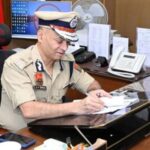
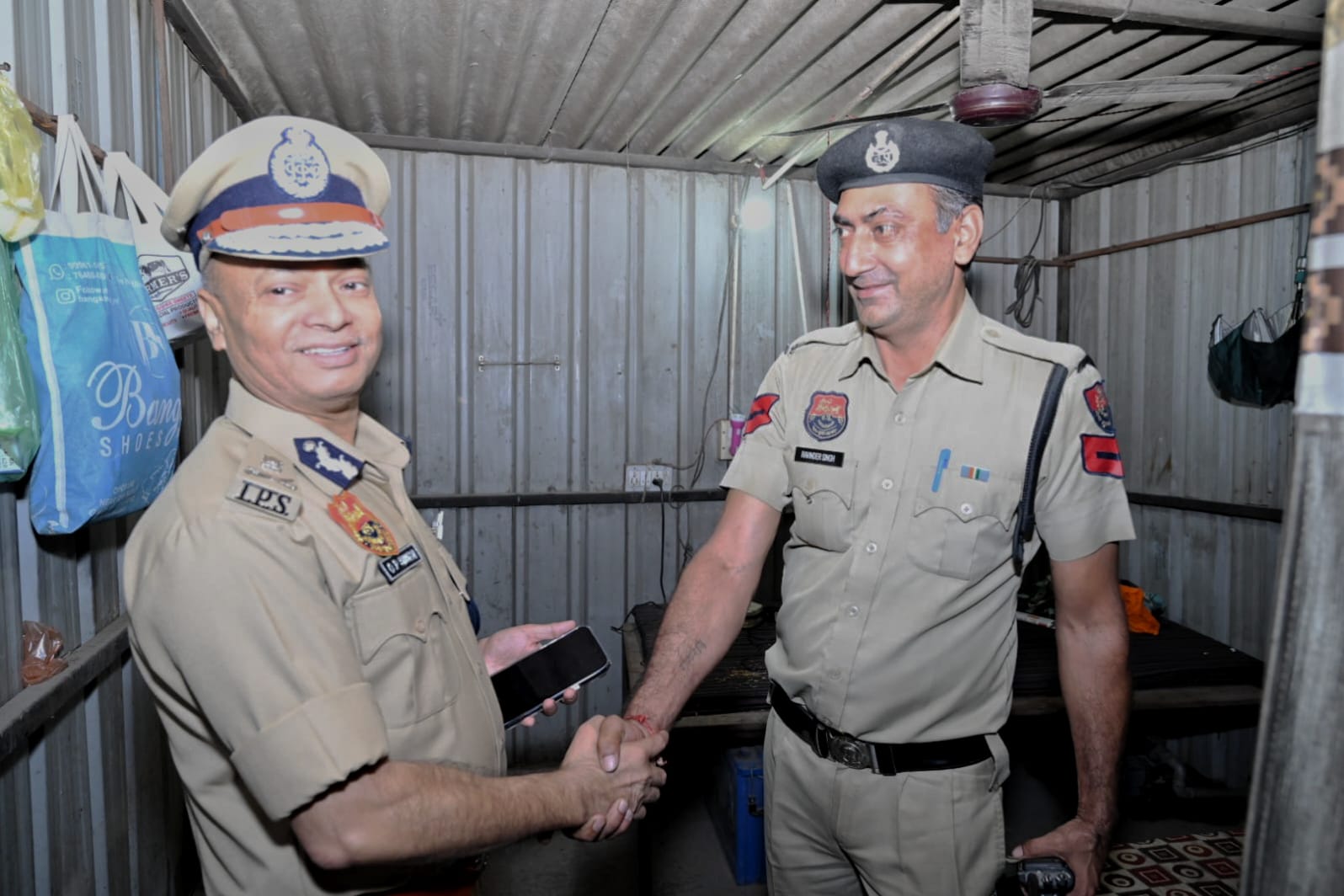
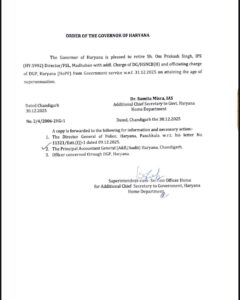
Chandigarh: The Haryana government on Tuesday evening formally ordered the retirement of Om Prakash Singh, IPS (1992 batch), who has been serving as Director, Forensic Science Laboratory (FSL), Madhuban, with additional charge of DG, Haryana State Narcotics Control Bureau (HSNCB) and officiating Director General of Police (DGP), Haryana. The order, issued in the name of the Governor of Haryana, confirms that Singh will retire from government service on December 31, 2025, upon attaining the age of superannuation.
The notification, signed by Additional Chief Secretary (Home) Dr Sumita Misra, brings the curtain down on a policing career that has been widely described within the force and by civil society as one of the most reform-oriented and people-facing tenures in Haryana’s recent law-and-order history.
A DGP with a Difference
Unlike many of his predecessors, O.P. Singh carved out a distinct identity as a DGP who believed that policing was as much about communication and moral leadership as it was about enforcement. A 1992-batch IPS officer with long experience across districts, ranges and specialised units, Singh steadily built a reputation as a field-oriented officer with a strong academic and reformist bent.
His tenure at the top coincided with a period when Haryana was grappling with complex challenges — organised crime, rising cyber frauds, narcotics trafficking, jailbreak-linked extortion rackets, and public distrust of policing institutions. Singh’s response was neither cosmetic nor confined to routine transfers and crackdowns. Instead, he attempted to reframe policing culture itself.
Open Letters That Changed Police Discourse
One of the most talked-about aspects of Singh’s leadership was his series of open letters addressed to senior police officers and the rank and file. Rare in Indian policing, these letters spoke candidly about integrity, empathy, professionalism and public accountability.
In these communications, Singh repeatedly reminded officers that fear cannot be the sole instrument of law enforcement and that respect for the uniform must be earned daily through conduct. He urged officers to treat complainants with dignity, discouraged misuse of power, and called upon SHOs and SPs to lead from the front rather than govern from files and air-conditioned offices.
Within police circles, these letters were seen as an attempt to morally re-anchor the force at a time when public confidence was under strain. For many young officers, it served as a written code of leadership ethics rather than mere administrative advisories.
Special Drives and Operational Push
Operationally, Singh oversaw and encouraged a series of focused, time-bound drives rather than diffused enforcement. These included intensified campaigns against narcotics networks through the HSNCB, targeted action against contract killers and organised gangs, and a renewed push on cybercrime awareness and prevention.
He placed particular emphasis on intelligence-led policing, urging district units to invest more in human intelligence and digital forensics. His insistence on coordination among field units, prisons, and technical agencies was aimed at breaking the ecosystem that allowed crimes to be orchestrated from jails or abroad.
Singh was also among the senior police leaders who publicly acknowledged the evolving nature of crime and the need to continuously retrain personnel — especially at the cutting edge — to deal with financial frauds, online extortion and digital evidence.
Public Image and Mass Acceptance
What set O.P. Singh apart was his relative popularity among the masses — an uncommon phenomenon for a serving DGP. His accessibility, restrained public demeanour and visible attempts to humanise policing earned him goodwill across social sections. Civil society groups, lawyers and even sections of the media often described him as a “thinking officer” who was willing to listen.
This public acceptance made him one of the more recognisable and favourably viewed DGPs Haryana has had since the state’s inception in 1966, strengthening the perception that his continuation could have lent stability to the police reforms already underway.
Why No Extension?
The decision not to grant Singh an extension has sparked quiet debate within administrative and political circles. While the retirement is officially in line with routine superannuation norms, insiders suggest multiple factors may have weighed in.
A larger view is that Singh’s reformist approach, particularly his emphasis on internal accountability and ethical policing, was not universally comfortable for entrenched interests — both within and outside the system. His tendency to communicate directly with the force, bypassing layers of conventional bureaucratic filtering, may have unsettled sections accustomed to the status quo.
Another factor cited is the delicate political calculus that often surrounds top police appointments and extensions. Even a popular DGP, sources indicate, is not immune to shifting administrative priorities, succession planning within the IPS hierarchy, and the government’s preference to signal institutional continuity rather than personality-centric leadership.
There is also the view that Singh’s parallel responsibilities — including FSL and HSNCB — while showcasing his versatility, may have diluted the perception of him as a long-term stabilising figure exclusively at the helm of the state police.
A Legacy Beyond Tenure
As O.P. Singh steps out of uniform, though his short term as a DGP for 79 days, his legacy is likely to be debated not in terms of headline-grabbing encounters or singular crackdowns, but in subtler shifts — a more reflective police leadership style, an attempt to rebuild internal morale through dialogue, and an insistence that authority must be matched with accountability.
In a system where policing often oscillates between coercion and crisis management, Singh’s tenure will be remembered as an experiment in reform through communication and conscience. Whether the momentum he created survives beyond his retirement will now depend on how his successors choose to engage with the force and the public alike.