



Listen To This Post
New Delhi/Chandigarh: Gig and platform workers across food delivery, quick commerce and ride-hailing services stayed off apps on Wednesday, observing a nationwide strike against platform companies over declining earnings, long working hours, safety concerns and arbitrary blocking of worker IDs. The protest saw participation from workers across food delivery, quick commerce, and ride-hailing platforms in major cities.
Delivery workers said a large number of riders chose not to log in during the day as part of the strike. Dharamvir, who has been working with Zomato and other platforms since 2019, said earnings have fallen sharply over the years, making it increasingly difficult for workers to sustain themselves.
“Earlier, a full-time worker could earn ₹2,500–3,000 a day. Today, after petrol, food and vehicle maintenance, you are left with just ₹700 or ₹800,” he said.
Safety Risks, Work Pressure and Fear of Retaliation
Workers also flagged serious safety concerns linked to tight delivery timelines.
“Fast delivery creates pressure. There have been cases where delivery boys have died. Still, the company does not provide any support,” Sushil said, adding that his ID was allegedly blocked after he participated in the protest.
According to worker groups, nearly 40,000 delivery workers across India had earlier taken part in a nationwide flash strike on December 25, 2025, leading to 50–60% service disruption in several cities.
Similar grievances were echoed by Prag, a JNU student and part-time gig worker associated with Rapido, Zomato and Swiggy. He said the promise of flexible work hours was largely illusory.
“If you slow down or log out, you are penalised. We earn around ₹7–7.5 per km, but after vehicle rent, petrol and daily platform charges, there is barely anything left,” he said.
Workers also complained of the absence of a credible grievance redressal system.
“No one listens. You either work or leave,” Dharamvir said. Prag added that while platforms refer to workers as ‘partners’, responsibility is routinely disowned. “If there is an accident, the first thing that happens is a penalty for not completing the order.”
Many workers admitted they continued working despite the strike call out of fear of retaliation. “People are scared their IDs will be banned. They don’t have the luxury to protest,” Prag said.
Union Demands and Labour Codes
The Gig and Platform Service Workers Union has submitted a memorandum to the Union Labour Ministry, noting that, despite the rapid expansion of the gig economy, workers remain excluded from core labour protections. The union has demanded minimum per-kilometre pay, an end to unrealistic 10–20 minute delivery targets, limits on deductions and penalties, protection against arbitrary ID blocking, and legal recognition of platform workers as workers under labour laws.
Under the Code on Social Security, 2020, which came into force in November 2025, gig and platform workers have been formally recognised for the first time and brought into a social security framework. Aggregators are now required to contribute 1–2% of their annual turnover—capped at 5% of payments to workers—to a Social Security Fund for benefits such as accident insurance, health and maternity cover, disability support and old-age protection. However, workers said the changes have yet to translate into meaningful relief on the ground. “Inflation keeps rising, but our pay keeps falling,” Prag said.
Raghav Chadha Spends New Year’s Eve With Protesting Workers
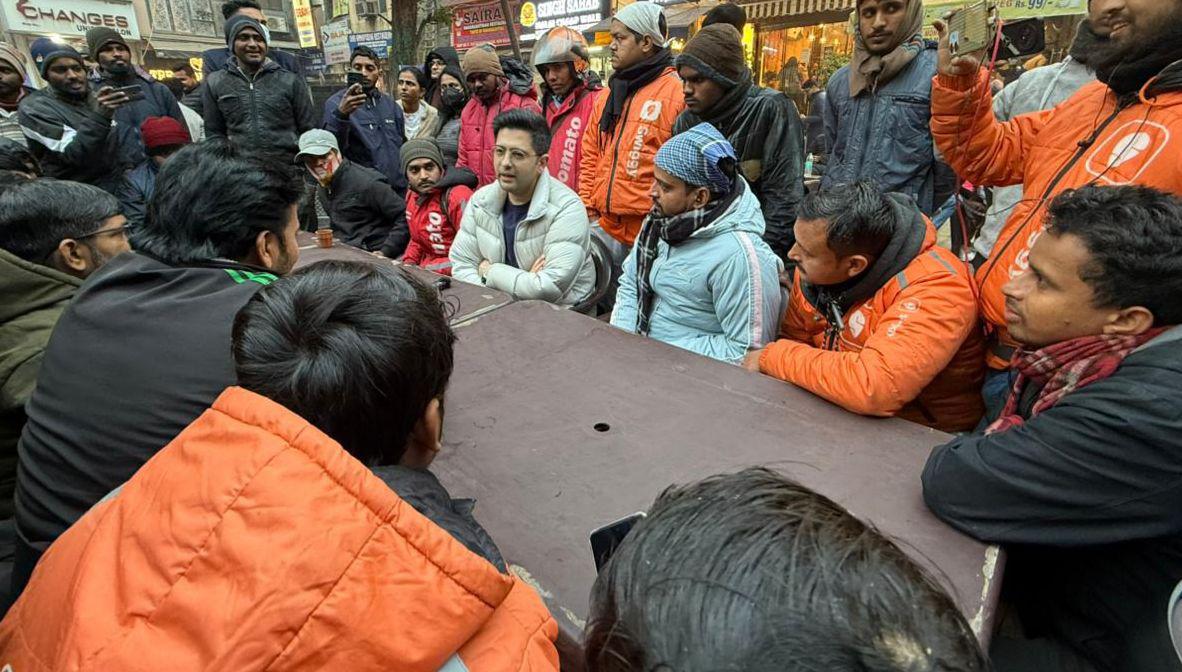
Amid the ongoing protests, Raghav Chadha, Rajya Sabha MP, spent New Year’s Eve with gig workers staging a symbolic protest at Old Rajinder Nagar in Delhi. Interacting with the workers, Chadha listened to their concerns about low and unpredictable pay, long working hours, lack of social security, and a lack of dignity at work. He noted that the protest was peaceful and aimed solely at drawing attention to the genuine hardships faced by gig workers, who form a crucial part of India’s urban workforce.
Expressing solidarity, Chadha said the workers’ demands for fair wages, humane working conditions, dignity and social security were legitimate and deserved serious consideration. He urged the management of platforms such as Blinkit, Zepto, Swiggy and Zomato to engage in meaningful dialogue with workers and arrive at fair and humane solutions.
“India’s growth cannot rest on insecurity and exploitation. It must be anchored in justice, dignity and respect for labour,” Chadha said.
Platforms Offer Incentives Ahead of New Year
Amid the strike call, food delivery platforms including Zomato and Swiggy rolled out additional incentives for delivery partners—a routine practice during festive and peak-demand periods—to minimise service disruptions ahead of New Year’s Eve. Workers, however, maintained that short-term incentives fail to address the deeper structural issues confronting India’s rapidly expanding gig workforce.