


Listen To This Post
DGP Ajay Singhal directs swift, sensitive action in volatile cases, and stronger preparedness
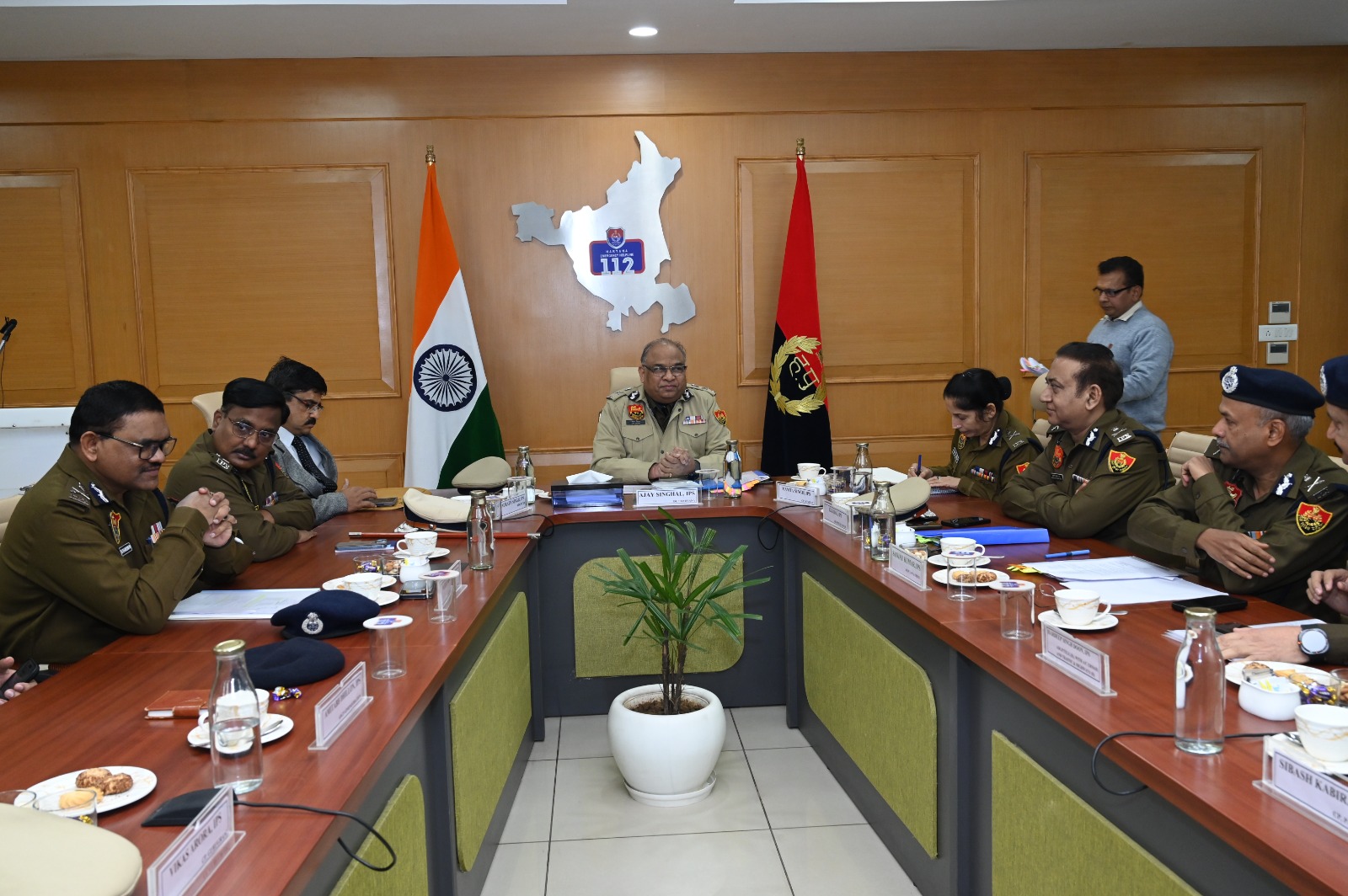
Chandigarh: With a clear focus on tightening crime control and strengthening law and order across the state, Ajay Singhal, Director General of Police, Haryana, on Monday, chaired a high-level review meeting at the Dial-112 auditorium in Panchkula. The meeting was attended by Additional Directors General of Police, Inspectors General, Police Commissioners, and Superintendents of Police from across Haryana.
Addressing senior officers, the DGP underlined that maintaining robust law and order remains the police department’s highest priority. He stressed that this objective can only be achieved through accountable, responsive, and proactive policing at the field level. Singhal announced that he would soon visit every police commissionerate, range, and district to personally review law-and-order arrangements, police deployment, and operational efficiency on the ground.
Swift action in sensitive and emotionally charged matters
Issuing firm directions, the DGP instructed district police chiefs to maintain close, continuous monitoring of sensitive matters involving students, farmers, religious issues, and caste-related disputes. He emphasised that such matters are often emotionally charged and can escalate rapidly if not addressed at the initial stage.
“Timely, balanced, and sensitive intervention is crucial,” Singhal said, adding that officers must act with impartiality, dialogue, and firmness to prevent deterioration of the situation. He also called for sustained coordination with police forces of neighbouring states to effectively manage inter-state issues and avoid tensions of spillover.
District- and police station-level crime analysis
The DGP directed all districts to undertake a detailed review of major crime categories, including crimes against women, murder, theft, robbery, and snatching. District heads were asked to analyse trends—both increases and declines—in these offences to identify effective strategies and enforcement gaps.
He noted that districts with better crime-control performance would serve as models, with their best practices replicated in areas with higher crime rates. Police Commissioners and Superintendents of Police were also instructed to conduct police station-wise crime analysis and initiate strict action wherever negligence or laxity is detected.
Focus on anticipation, intelligence, and dialogue.
Briefing the meeting, Sanjay Kumar, Additional Director General of Police (Law & Order), said that every district has its own social, geographical, and sensitivity-related challenges. He stressed the need for officers to anticipate potential flashpoints well in advance and maintain a ready, district-specific plan of action.
He highlighted the importance of strengthening intelligence and information networks and of acting promptly on received inputs. Kumar observed that many disputes can be defused at an early stage through timely dialogue and communication, thereby preventing escalation into larger law-and-order problems.
Preparedness of law & order companies
Special emphasis was laid on the preparedness of law-and-order companies. ADGP Sanjay Kumar directed regular briefings, continuous, practical training, the availability of master trainers, and periodic review of deployment strategies. He said these units must remain in a constant state of readiness to respond swiftly and decisively to any untoward incident.
Instructions were also issued to maintain a roster of capable officers skilled in handling challenging law-and-order situations. Regular debriefing of personnel was stressed to improve response time and ensure effective control during emergencies.