


Listen To This Post
Far from a ceremonial appearance, Modi’s words, gestures, and announcements were carefully laden with cultural symbolism and electoral messaging.
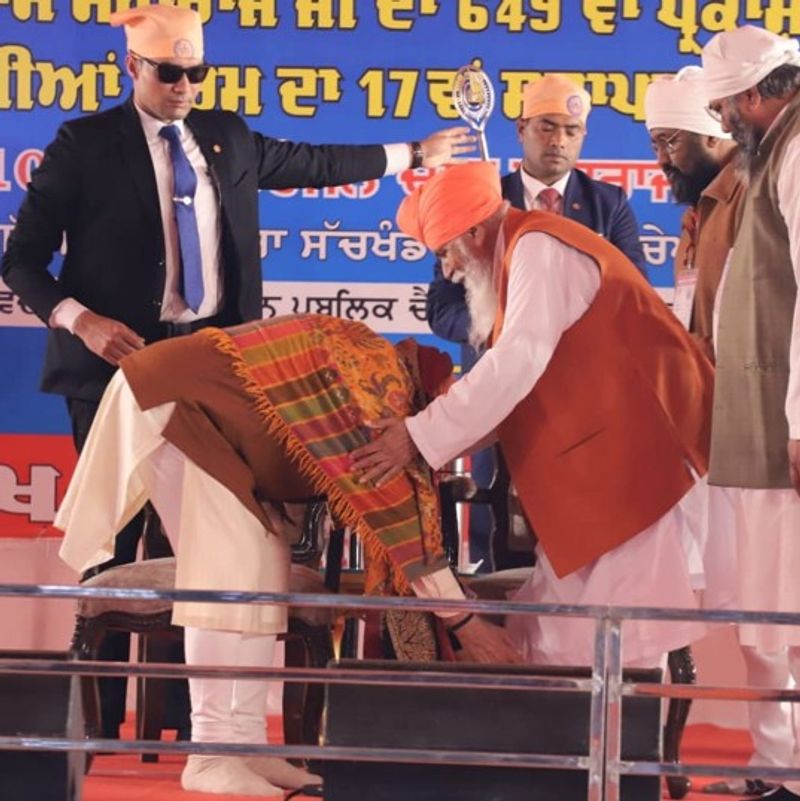
Chandigarh: Prime Minister Narendra Modi’s visit to Dera Sachkhand Ballan(Jalandhar) on the 649th birth anniversary of Guru Ravidas has added a distinctly political dimension to Punjab’s evolving pre-2027 Assembly election landscape. Far from a ceremonial appearance, Modi’s words, gestures, and announcements were carefully laden with cultural symbolism and electoral messaging.
Opening his address in Punjabi with the emotionally resonant line, “Mein Punjab di iss dharti nu naman karda haan,” the Prime Minister struck a chord with the gathering at Ballan. The phrase, repeatedly highlighted by BJP leaders later in the day, was widely interpreted as an attempt to signal a personal connection and respect for Punjab’s soil, history, and social movements—particularly those rooted in Dalit assertion.
Ravidas legacy and personal political narrative
Modi went on to remind the audience that Varanasi, his Lok Sabha constituency, is also the birthplace of Guru Ravidas. “People of Varanasi gave me blessings, and I got the opportunity to serve that place as an MP,” he said, subtly weaving his own political journey with the spiritual legacy of the saint. By doing so, he sought to project continuity between Bhakti-era social reform and contemporary governance, reinforcing the BJP’s broader narrative of inclusive development.
Invoking Guru Ravidas repeatedly, Modi said, “We take inspiration from Guru Ravidas. With the blessings of Sant Ravidas, I am confident that we will achieve the target of Viksit Bharat.” In Punjab’s political context, the reference to Viksit Bharat was not just a national slogan but an attempt to align Dalit aspirations with the BJP’s long-term development vision.
Direct outreach to Ravidassia leadership
Praising the social service work of the Dera, Modi said the contribution of Sant Niranjan Dass and Dera Sachkhand Ballan in education, social reform and community welfare was “praiseworthy.” This public endorsement gains added significance as it comes days after Sant Niranjan Dass was named for the Padma Shri, reinforcing the perception that the Centre is consciously engaging with influential Ravidassia institutions.
In Punjab, where religious deras often shape political opinion at the grassroots, such acknowledgement from the Prime Minister is seen as a signal of political validation—something that could influence voting behaviour in the Doaba belt.
Infrastructure announcements as cultural messaging
Before reaching the dera, Modi renamed the Adampur airport as Shri Guru Ravidass Maharaj Ji Airport, a move that blends infrastructure development with cultural recognition. The virtual inauguration of the Halwara civil terminal in Ludhiana further strengthened the development pitch. For the BJP, linking visible projects to revered Dalit icons serves as a strategic tool to counter perceptions of political marginalisation.
Implications for 2027 Assembly elections
Punjab has 32% Dalits, and the Doaba remains the epicentre of Dalit political influence. Modi’s Ballan visit is therefore being read as an early attempt to consolidate Dalit outreach well ahead of the 2027 Assembly elections. Even marginal gains for the BJP in this segment could disrupt established vote patterns and complicate the electoral arithmetic for both the ruling Aam Aadmi Party and the opposition Indian National Congress.
By combining Punjabi-language emotional appeal, reverence for Guru Ravidas, praise for the dera’s leadership and high-visibility infrastructure decisions, the Prime Minister’s visit sent a clear message: the BJP intends to be an active player in Punjab’s Dalit-centric politics, not just in 2027, but in the long run.
In that sense, “Punjab di dharti nu naman” was not merely a greeting—it was a carefully chosen political statement aimed at reshaping the narrative in a state where identity, faith and elections are deeply intertwined.