



Listen To This Post
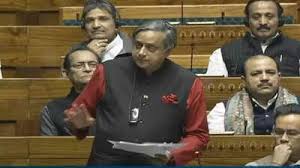
New Delhi: Congress leader Shashi Tharoor on Tuesday mounted a scathing attack on the Union Budget 2026–27 in the Lok Sabha, calling it an “underwhelming” exercise and a “squandered opportunity” that prioritises headlines over delivery, fiscal prudence over fairness, and announcements over outcomes.
Participating in the general discussion on the Budget, Tharoor said while the government had muted the “loud horn” of last year’s Budget, it failed to address underlying economic stresses. He likened the exercise to “rearranging the airbags on a crashing car while assuring passengers that the chassis is sturdy”.
“This Budget is praised for prudence, but prudence without vision or fairness is hollow,” Tharoor said, accusing the Centre of ignoring unemployment, rising living costs and widening inequality. “It offers little to address the real struggles of the aam aadmi,” he added.
Citing media reports, Tharoor alleged that governance had degenerated into “headline management”, pointing to chronic underutilisation of funds. Of over ₹5 lakh crore allocated last year to 53 major welfare and infrastructure schemes, barely 41 per cent was spent in the first nine months, he said, flagging “astonishingly low” utilisation in flagship programmes such as the Jal Jeevan Mission and PM Schools for Rising India.
On the macroeconomic front, Tharoor said fiscal consolidation since the pandemic had relied largely on expenditure compression rather than revenue reform. He warned that the tax burden had steadily shifted from corporations to individuals, noting that personal income tax now accounts for a larger share of GDP than corporate tax, despite robust post-pandemic profit growth.
Turning to agriculture, he said the sector—supporting over 60 per cent of the population—had been allocated just 3 per cent of the Budget at ₹1.62 lakh crore, marking a reduction from last year. He flagged climate risks, farm distress and declining allocations for agricultural research, while alleging that schemes such as PM Fasal Bima Yojana had failed farmers through “token” compensation.
On employment, Tharoor pointed to persistent rural and urban joblessness, noting that urban unemployment had risen to 6.7 per cent by December 2025. He criticised poor outcomes in skilling and internship schemes and the Budget’s silence on the welfare of gig workers.
He also questioned the replacement of MGNREGA with the Viksit Bharat Gram Rozgar Act, arguing that it diluted the legal right to work, capped central funding and risked exclusion due to excessive reliance on digital systems.
Accusing the Centre of neglecting Kerala, Tharoor flagged underinvestment in railways, lack of support for Vizhinjam port connectivity, absence of coastal protection funding, and delays in aviation projects. He said education and health spending remained far below promised levels, with no clarity on a long-pending AIIMS in the state.
Tharoor further criticised regional imbalance in new institutional announcements, inadequate R&D spending, and continued dependence on China for pharmaceutical inputs. He warned that rising EMIs were squeezing the middle class, credit card debt was mounting, and a growing tax burden was looming, with no relief measures in sight.
Questioning the government’s infrastructure-led growth strategy, he argued that high capital expenditure had failed to generate adequate jobs or crowd in private investment. He also raised concerns over the interim trade agreement with the United States, calling it “less a free trade agreement and more a pre-committed purchase agreement”. “Viksit Bharat cannot be built on slogans and symbolism,” Tharoor said. “It must be built on delivery that reaches the last citizen.”