


Listen To This Post
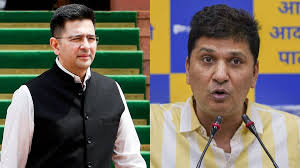
New Delhi: The simmering feud between Raghav Chadha and the Aam Aadmi Party (AAP) exploded into an all-out public confrontation on Friday morning, as the party dramatically dropped all pretence of internal diplomacy and launched a fierce, coordinated offensive against its own Rajya Sabha MP. What had until recently been a tension managed behind closed doors has now spilled onto the most public of stages — with both sides trading blows through videos, press statements, and pointed political rhetoric.
Chadha Fires First — Party Fires Back Harder
The escalation was set in motion when Raghav Chadha released a video asserting defiantly that while AAP may have attempted to silence him, it had not — and could not — defeat him. It was a combative declaration, clearly designed to signal that he had no intention of quietly accepting the party’s recent punitive actions against him.
The party, however, was not in the mood for half-measures. Within moments of Chadha’s video going public, AAP fielded one of its most senior and combative leaders — Saurabh Bhardwaj, the party’s Delhi in-charge — to deliver a swift and stinging rebuttal. The message was unmistakable: AAP was not going to allow Chadha to position himself as a victim without a fight.
Bhardwaj Goes for the Jugular: “You Hid When Kejriwal Was Arrested”
In a hard-hitting video of his own, Bhardwaj did not mince words, going straight for what he clearly believes is Chadha’s most damaging vulnerability — his conspicuous absence during the party’s darkest hour.
“When Arvind Kejriwal, as the sitting Chief Minister, was arrested in the Delhi liquor scam, you were not even in the country. You hid somewhere,” Bhardwaj said, his tone dripping with barely concealed contempt.
It was a devastating charge — one that strikes at the very heart of what AAP demands from its leaders: unflinching loyalty, solidarity, and courage in the face of adversity. For a party that has built its identity around the image of fearless warriors battling a powerful establishment, the accusation that Chadha went into hiding during the arrest of its supreme leader carries an almost existential weight.
The “Joh Dar Gaya, Samjho Mar Gaya” Doctrine
Bhardwaj framed his broadside around what he presented as AAP’s founding political philosophy — one that leaves no room for timidity or accommodation with the ruling dispensation.
“We all are soldiers of Kejriwal. We have learnt just one thing — joh dar gaya, samjho mar gaya. We have to raise people’s issues looking the government in the eye,” he declared, invoking the Hindi phrase — roughly translated as “he who is afraid is already dead” — that has long served as a rallying cry within the party’s ranks.
He went on to accuse Chadha of precisely the kind of political cowardice that the phrase condemns, saying the MP was “too afraid to look the BJP in the eye or question the PM or the government.” For a leader who has cultivated an image as one of AAP’s sharpest and most articulate voices, the charge was as humiliating as it was pointed.
“The BJP Has Been Supporting You on Social Media”
Perhaps the most explosive allegation Bhardwaj levelled was the insinuation — carefully worded but unmistakably clear — that Chadha’s brand of politics was not merely ineffective, but actively beneficial to the party’s principal adversary.
“Your soft issues do not bother the BJP. The BJP has been supporting you on social media since yesterday,” Bhardwaj said pointedly, raising the spectre of a deeply uncomfortable question: whose interests was Chadha’s parliamentary conduct actually serving?
The accusation of receiving tacit support from the BJP is, in AAP’s political universe, among the gravest that can be made against a party member. It is a charge that goes beyond incompetence or indiscipline — it edges toward the territory of political betrayal.
A Catalogue of Failures: Electoral Fraud, Gujarat Arrests, and the Impeachment Motion
Bhardwaj proceeded to lay out what amounted to a detailed charge sheet against Chadha, cataloguing a series of specific instances in which, he alleged, the MP had failed to stand with his party and the wider Opposition on issues of national importance.
He pointed to the Opposition’s attempt to bring a motion to impeach the Chief Election Commissioner over the alleged disenfranchisement of genuine voters — a move, he said, that the entire Opposition had united behind. “You refused to sign it,” Bhardwaj said flatly.
He also highlighted the situation in Gujarat, where he claimed 160 AAP workers had been booked in what the party describes as fabricated cases. “You were silent on that. So many of our leaders were jailed. You were not even in the country,” he said, returning again to the allegation that Chadha had been absent without explanation at a moment of acute crisis for the party.
On the issue of the alleged deletion of genuine voter rolls — a matter AAP and several Opposition parties have flagged in multiple states, including West Bengal — Bhardwaj noted that Chadha had failed to walk out with the Opposition on what had been a commonly articulated position. “How will this politics of fear work?” he asked, signalling what party insiders are now describing as an irreparable rupture between Chadha and AAP’s core leadership.
The “Samosa” Jibe: More Than a Punchline
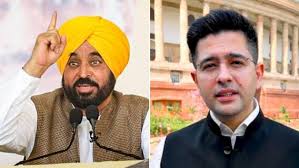
The now-famous samosa reference — first deployed by Punjab Chief Minister Bhagwant Mann — resurfaced in Bhardwaj’s offensive as well, this time with added context. AAP made clear that the jibe was a deliberate, targeted swipe at Chadha’s sustained Rajya Sabha campaign around the issue of affordable food at airports — a cause he had championed with considerable media attention.
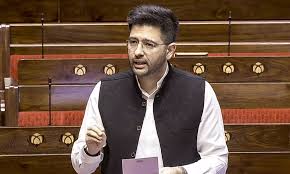
“Parties have limited time in Parliament and therefore it is more important to raise bigger issues than samosas,” Bhardwaj said pointedly, drawing a sharp contrast between Chadha’s chosen parliamentary battles and the high-stakes political fights AAP believes its MPs should be waging.
The underlying accusation is one that cuts deeper than it might initially appear: AAP is essentially arguing that Chadha has been using the Parliament’s platform not to serve the party’s political agenda, but to carefully curate and cultivate his own personal brand — a charge of self-promotion that sits uneasily within a party that has always demanded the subordination of individual identity to collective purpose.
The Bigger Picture: Image-Building vs. Party Line
At its core, the AAP-Chadha dispute is a clash between two fundamentally different visions of what a party legislator’s role should be. AAP’s leadership argues that Chadha has been systematically building his own public image — through accessible, relatable campaigns on airport food prices, consumer issues, and other non-confrontational topics — while simultaneously softening his stance on the issues that define AAP’s core identity: its head-on confrontation with the BJP and Prime Minister Narendra Modi.
Chadha, for his part, maintains that he has done nothing wrong — that the people’s issues he has raised in Parliament are entirely legitimate, and that his conduct should not be a cause for concern within his own party.
The BJP Speculation Hangs in the Air
The timing of this spectacular falling-out has not gone unnoticed by political observers. It comes just days after AAP’s senior leader Sanjay Singh was compelled to publicly dismiss speculation that Chadha — a former AAP co-in-charge of Punjab — was considering a switch to the BJP ahead of the 2027 Punjab assembly elections. The fact that such speculation existed at all and required a senior leader’s denial speaks volumes about the depth of distrust that has taken root.
Whether Chadha ultimately reconciles with the party, faces formal disciplinary action, or charts an altogether different political course remains to be seen. But with AAP now openly questioning not just his conduct but his loyalty — and with the BJP’s alleged social media support for him being cited as evidence — the road back to the party’s inner circle appears, for now, to be a very long one indeed.