






Listen To This Post
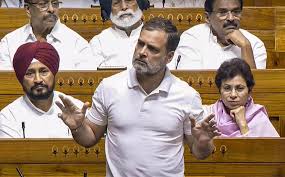
New Delhi/Chandigarh: The BJP on Thursday strongly countered Congress leader Rahul Gandhi’s claim that manufacturing in India is declining, calling it “fake” and “unsupported by data,” even as fresh official figures revealed a steady contraction in Haryana’s industrial base, raising questions about uneven growth across states.
BJP spokesperson Amit Malviya said national manufacturing output, exports and employment have expanded sharply over the past decade, particularly in electronics and mobile manufacturing, contradicting Rahul Gandhi’s assertions.
BJP Cites National Manufacturing Surge
Malviya said India has emerged as a net exporter in key sectors such as electronics, pharmaceuticals, engineering goods and defence, backing his argument with data:
- Electronics production:
₹1.9 lakh crore (2014–15) → ₹11.3 lakh crore (2024–25) - Electronics exports:
₹38,000 crore → ₹3.27 lakh crore - Mobile manufacturing units:
2 units → nearly 300 units - Mobile phone production:
₹18,000 crore → ₹5.45 lakh crore - Mobile phone exports:
₹1,500 crore → ₹2 lakh crore
He said manufacturing continues to be one of India’s largest employment generators, claiming around 17 crore jobs created in the last decade.
Quoting the Periodic Labour Force Survey (August 2025), Malviya pointed to:
- Worker Population Ratio: 52.2%
- Female Worker Population Ratio: 32%
- Female Labour Force Participation Rate: 33.7%
- Unemployment Rate: 5.1%
- Manufacturing job growth rising from 6% (2004–14) to 15% in the past decade
“The claim that production in India has gone down is inconsistent with evidence,” Malviya said.
Haryana’s Factory Count Shrinks for Fifth Straight Year
However, data sourced from the Annual Survey of Industries, released by the Ministry of Statistics and Programme Implementation and cited by the RBI, presents a more complex picture at the state level.
Despite the Nayab Singh Saini government’s emphasis on ease of doing business, Haryana recorded 10,389 registered factories in 2023–24, down from 10,603 the previous year — a loss of 214 units.
More significantly, this marks the fifth consecutive year of decline since the state peaked at 11,835 factories in 2018–19. Over five years, Haryana has lost 1,446 factories, a contraction of 12.2%, raising concerns about its industrial competitiveness.
Punjab Expands While Haryana Contracts
In contrast, Punjab has shown relative stability and long-term growth, with 13,166 factories in 2023–24, only marginally lower than the previous year, and 341 units added over the past five years.
Over two decades:
- Haryana:
4,339 factories (2004–05) → 10,389 (2023–24) — 139% growth - Punjab:
7,575 factories → 13,166 — 74% growth
Notably, Punjab has consistently maintained a larger industrial base, with the gap widening in recent years.
National Picture Remains Strong, But Uneven
At the all-India level, the total number of factories rose to 2.6 lakh in 2023–24, up by 6,727 units from the previous year.
- Gujarat remained the industrial powerhouse with 33,311 factories, adding 2,280 units.
- Uttar Pradesh saw the sharpest jump, adding 3,039 factories to reach 22,141 units.
- Delhi witnessed a steep decline of 290 factories, while Uttarakhand and Himachal Pradesh posted modest gains.
The Broader Takeaway
While the BJP’s data underscores a robust national manufacturing expansion, especially in export-oriented sectors, state-level figures reveal regional disparities, with Haryana’s prolonged industrial decline standing out amid broader growth.
The contrast suggests that while India’s manufacturing story may be strengthening at the macro level, state-specific policy outcomes and competitiveness gaps continue to shape very different industrial trajectories on the ground.