


Listen To This Post
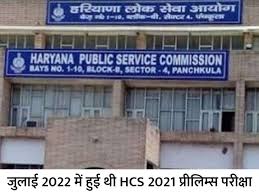
Chandigarh: In a major administrative reform aimed at streamlining recruitment to top executive posts, the Haryana Government on Thursday revised the syllabus for the Haryana Civil Service (Executive Branch) and Allied Services Examinations. The changes were notified through an extraordinary gazette notification issued by Chief Secretary Anurag Rastogi.
The overhaul marks a decisive shift towards a more uniform, generalist-oriented assessment framework, broadly aligned with the UPSC civil services pattern, with a clear emphasis on governance, ethics, analytical ability and Haryana-specific knowledge.
Preliminary Examination: Two Objective Papers, 400 Marks
Under the revised structure, the Preliminary Examination will comprise two objective-type papers, each carrying 200 marks.
Paper I: General Studies
Paper I will test candidates on a vast canvas of topics, including:
-
General science, based on everyday observations expected of an educated person
-
Current events of national and international importance
-
Indian history, with emphasis on the freedom struggle and post-Independence developments
-
Indian and world geography, covering physical, social and economic aspects, agriculture and natural resources
-
Indian polity, economy and culture
-
Mental ability and reasoning
Haryana-specific components—such as the state’s economy, people, social institutions, culture and language—have been woven into the syllabus across themes rather than treated as a standalone section.
Paper II: Civil Services Aptitude Test (CSAT)
The second paper will assess:
-
Comprehension
-
Interpersonal and communication skills
-
Logical reasoning and analytical ability
-
Decision-making and problem-solving
-
General mental ability
-
Basic numeracy (Class X level)
-
Data interpretation from charts, graphs and tables
Mains Examination: Six Descriptive Papers, No Optional Subjects
One of the most significant reforms is in the Main Written Examination, which now consists of six descriptive papers, each of three hours’ duration and 100 marks, totalling 600 marks.
In a significant departure from earlier practice, optional subjects have been eliminated, a move confirmed in recent updates issued by the Haryana Public Service Commission (HPSC).
Paper I: English and Essay
This paper will test:
-
Comprehension of serious prose
-
Precis writing
-
Usage, vocabulary and grammar
-
Composition skills
-
An essay on a chosen topic, focusing on clarity, coherence and orderly presentation of ideas
Paper II: Hindi and Hindi Essay (Devnagri Script)
The Hindi paper will include:
-
Translation from English to Hindi
-
Letter and precis writing
-
Explanation of prose and poetry
-
Idioms, corrections and composition
-
A topic-based essay in Hindi
Four General Studies Papers Introduced
General Studies I
Covers:
-
Indian art, culture, literature and architecture (ancient to modern)
-
Modern Indian history and the freedom struggle
-
Post-Independence consolidation
-
World history, including the Industrial Revolution, wars, colonisation and political ideologies
-
Indian society—diversity, women, population, poverty, urbanisation, globalisation, communalism, secularism and regionalism
-
Physical and human geography, climate phenomena and environmental changes, with Haryana-specific linkages
General Studies II
Focuses on:
-
Indian Constitution, amendments and federal structure
-
Governance, separation of powers and dispute resolution
-
Parliament, state legislatures, executive and judiciary
-
Constitutional and statutory bodies
-
Representation of the People Act
-
Welfare schemes, social justice, health, education and poverty alleviation
-
Role of NGOs and self-help groups
-
India’s foreign relations, neighbourhood policy, global institutions, diaspora and Haryana-specific governance issues
General Studies III
Includes:
-
Indian economy: planning, growth, employment and budgeting
-
Agriculture, MSP, irrigation, food security, PDS and allied activities
-
Industrial policy, liberalisation and infrastructure
-
Science and technology applications, IT, space, biotechnology and IPR
-
Environment, climate change and disaster management
-
Internal security challenges, including extremism, cyber threats, organised crime and border issues, with relevance to Haryana
General Studies IV: Ethics, Integrity and Aptitude
This paper will use case studies to assess:
-
Ethics in public life
-
Human values derived from leaders and reformers
-
Attitude formation and moral reasoning
-
Civil service values such as integrity, impartiality and empathy
-
Emotional intelligence
-
Public service ethics, accountability and probity in governance
-
Transparency tools like RTI, citizen charters and challenges of corruption
A Shift Towards Governance-Centric Recruitment
Officials said the revised syllabus is designed to ensure that future civil servants possess broad-based knowledge, ethical grounding and practical governance insight, rather than subject-specific specialisation.
The changes are expected to reduce syllabus fragmentation, improve fairness, and better equip officers to handle Haryana’s administrative and developmental challenges, even as the state prepares for a new generation of leadership in its civil services.