



Listen To This Post
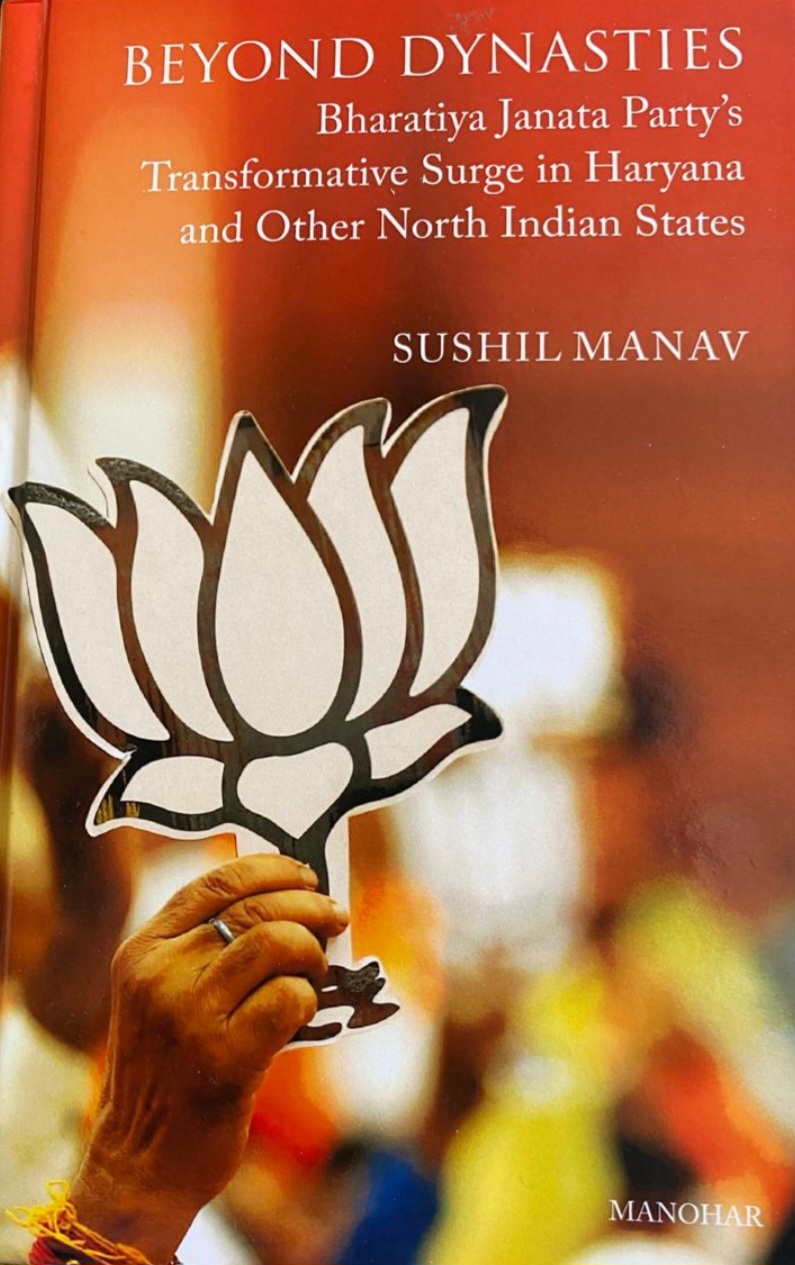
Book Review| ‘Beyond Dynasties: BJP’s Transformative Surge in Haryana and Other North Indian States’
Author: Sushil Manav | Publisher: Manohar Publishers & Distributors | 327 pages | ₹995
Reviewed By: ANURADHA| THE NEWS DOSE.COM
Political reporters spend decades watching power change hands, alliances shift and leaders rise and fall. Yet only a few attempt to step back and convert those years of ground reporting into a larger narrative about how politics itself is evolving. In Beyond Dynasties: BJP’s Transformative Surge in Haryana and Other North Indian States, senior journalist Sushil Manav makes such an attempt, drawing on over three decades of covering north Indian politics to trace the decline of traditional political dynasties and the rise of the Bharatiya Janata Party (BJP) across the region.
The book is not written as a polemic. Nor is it a political manifesto. Instead, it reads like an extended field report — a journalist’s attempt to document a significant transformation underway in the politics of states such as Haryana, Uttar Pradesh, Delhi, Punjab and Uttarakhand. Manav argues that the BJP’s rise in these states reflects more than just electoral success; it represents a structural shift from family-dominated politics towards a more centralised, organisationally driven political model.
The narrative’s anchor is Haryana, the state Manav has reported on most extensively. For decades, Haryana’s politics revolved around powerful political families and caste-based power blocs. The book carefully traces how the BJP, once a marginal player in the state, managed to break this pattern and secure consecutive mandates in 2014 and 2024 — something no party had achieved in Haryana since 1972.
According to the author, a key factor behind this shift was the dismantling of the entrenched “parchi-kharchi” system — the informal patronage network through which government jobs and services were allegedly distributed. The BJP government, he notes, sought to replace this culture with digitised recruitment, technology-driven welfare delivery and administrative reforms such as the Parivar Pehchan Patra family ID system. Equally significant was the party’s effort to build a social coalition that extended beyond the traditional Jat political dominance to include OBCs, Dalits and other communities.
The chapters dealing with former Haryana Chief Minister Manohar Lal Khattar are among the most engaging. Manav recounts the unusual political journey of an RSS pracharak with no prior electoral background who went on to lead the state for nearly a decade. The author describes the governance changes introduced during Khattar’s tenure, including digitised bureaucratic processes, the CM Window grievance system and claims of transparent recruitment.
At the same time, the narrative does not shy away from controversies. Issues such as e-tendering disputes, property ID complaints and the arrest of an HPSC officer in a recruitment scam are also recorded. This balance between reform and criticism lends the book a credibility that purely partisan accounts often lack.
One of the book’s strengths lies in its ground-level reportage. Manav draws on countless conversations and field observations accumulated during years of reporting. He recounts stories of individuals who believe their lives changed because of shifts in governance — a young man from a poor family entering the civil services through a transparent recruitment process, a small trader navigating new tax structures, or rural households benefiting from welfare schemes. These anecdotes give the book a distinctly journalistic texture.
However, the book’s wide scope also creates limitations. Attempting to cover five states and nearly three decades of political developments within 327 pages inevitably leads to uneven depth. While Haryana receives detailed treatment, sections on Punjab and Uttarakhand feel comparatively brief. Some themes — such as the impact of caste tensions during the Jat reservation agitation or the broader implications of electoral survey data — could have been examined more thoroughly.
Despite these gaps, Beyond Dynasties offers an informative account of the organisational and political strategies behind the BJP’s expansion in north India. The book describes the party’s grassroots mobilisation techniques, including its booth-level structure, data-driven campaigning and use of social media to amplify governance narratives.
In the end, Manav does not attempt to deliver a definitive judgement on the BJP or its rivals. Rather, he presents a reporter’s account of a political order in transition. The traditional model of dynasty-driven politics, he suggests, has been significantly challenged — though whether the new system will produce deeper democratic change or simply a different form of political consolidation remains an open question.
For readers interested in contemporary north Indian politics, Beyond Dynasties serves as a useful chronicle — not a final verdict, but a journalist’s record of how the region’s political landscape has been reshaped over the past decade.