




Listen To This Post
For a generation raised on smartphones and digital platforms, such innovations transform agriculture into a technology-enabled enterprise, where data, analytics and digital tools are as important as tractors and irrigation.

Written By: AS MITTAL | THE NEWS DOSE.COM
New Delhi/Chandigarh, Updated At: 7.35 PM April 5, 2026 IST
A doctor, an engineer, an advocate, a bureaucrat, or a businessman often dreams of seeing their next generation carry forward the same profession with pride to a new scale. A farmer, however, stands as a poignant exception—rarely wishing that his children inherit the plough. This quiet but powerful truth captures the emotional and structural crisis at the heart of Indian agriculture.
One of the silent crises confronting Indian agriculture is the growing disconnect between the younger generation and farming. Across rural India, many young people are reluctant to continue traditional agriculture, seeing it as a profession marked by uncertain incomes, hard physical labour and volatile markets. Migration to cities and even overseas in search of stable employment has increasingly become the preferred path, leaving ageing farmers and fragmented landholdings behind.
Yet agriculture remains central to India’s economy and social stability. The sector still employs nearly 46 per cent of the country’s workforce while contributing about 16 per cent to GDP—an imbalance that underlines both its vast scale and deep productivity challenges it faces.
In this context, Artificial Intelligence (AI) may emerge not just as a technological upgrade but as a transformative force. By turning agriculture from labour-intensive subsistence to data-driven, precision-based smart farming, AI has the potential to make farming more profitable, efficient and—most importantly—more aspirational for the younger generation once again.
From Traditional Farming to Smart Farming
Artificial Intelligence is gradually redefining how agriculture operates. AI-enabled systems can analyse satellite imagery, soil health data, rainfall patterns and crop growth indicators to generate real-time farm advisories.
These tools can guide farmers on optimal sowing time, fertiliser application, pest management and market timing, allowing them to make informed decisions based on data rather than uncertainty.
Globally, precision agriculture technologies have already demonstrated strong results. Studies suggest AI-based farming practices can increase crop productivity by 20–30 per cent while significantly reducing water and chemical inputs.
For a generation raised on smartphones and digital platforms, such innovations transform agriculture into a technology-enabled enterprise, where data, analytics and digital tools are as important as tractors and irrigation.
Opportunities and Challenges in India’s AI Journey
India’s agricultural ecosystem presents both immense opportunities and structural challenges for AI adoption.
The country produces vast volumes of agricultural data—from weather records and soil maps to satellite imagery and crop surveys. Yet less than 5 per cent of Indian farmers currently use digital advisory tools, indicating that the potential for technology-led productivity gains remains largely untapped.
AI-driven platforms are beginning to bridge this gap. Multilingual advisory tools such as Kisan e-Mitra already respond to thousands of farmer queries daily on crop practices, government schemes and market trends.
Research initiatives like ANNAM.AI at IIT Ropar are also developing AI-based advisory platforms that translate agricultural data into practical field-level recommendations.
Early pilot projects suggest these systems can reduce cultivation costs by 8–12 per cent while increasing yields by 10–20 per cent, demonstrating the real economic value of digital agriculture.
Will AI Replace Farm Labour?
Concerns are often raised that artificial intelligence and automation may displace agricultural labour.
However, India’s farm structure—dominated by small and fragmented landholdings—makes large-scale automation difficult. Instead of eliminating jobs, AI is more likely to transform the nature of rural employment.
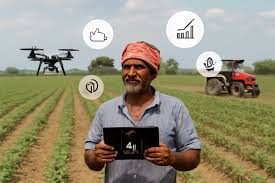
New professional roles are already emerging, including agri-data technicians managing farm analytics platforms, drone operators offering precision spraying services, and supply-chain specialists using data for storage, grading and marketing.
Progressive agricultural states such as Punjab and Haryana—long known for green revolution and pioneering mechanisation—are already experimenting with drones for crop monitoring and pesticide spraying, signalling how digital technologies could reshape rural livelihoods.
Rather than reducing employment, AI may therefore upgrade agriculture from manual labour to skilled rural services, making it more attractive for educated youth.
Global Lessons: Technology Attracting Young Farmers
International experiences demonstrate that when agriculture becomes technology-driven, it naturally attracts young professionals.
A compelling example comes from China’s rice sector, illustrating how technology and scientific farming can dramatically improve productivity. India cultivates rice across roughly 44 million hectares, while China has reduced its rice area to about 28 million hectares. Yet despite cultivating 16 million hectares less, China’s rice production trails India’s by only about 5 million tonnes.
The reason lies in productivity. India’s average rice yield is around 2.3 tonnes per hectare, whereas China achieves nearly 4 tonnes per hectare—almost 70 per cent higher, thanks to advanced technologies, better crop management and precision farming.
In the United States, AI-enabled technologies such as the “See & Spray” system use computer vision to detect weeds and apply herbicides only where necessary, reducing chemical use by nearly 90 per cent. In Israel, AI-powered irrigation systems optimise water usage by analysing soil moisture and weather data in real time.
These examples underline how technology-driven agriculture can boost productivity while attracting young innovators, engineers and agri-tech entrepreneurs.
Making Agriculture Aspirational Again
India’s next agricultural silent transformation may emerge from the fusion of digital intelligence with farming practices.
Artificial Intelligence can also help address one of the structural challenges of Indian agriculture—the over-dependence on the wheat–rice cropping cycle, particularly in states such as Punjab and Haryana. By analysing soil health, water availability, climate patterns, and global market demand, AI can guide farmers toward high-value, export-oriented crops such as fruits, vegetables, pulses, oilseeds, and horticultural produce.
Such diversification not only improves farm incomes but also enhances environmental sustainability and water conservation. For young farmers, this shift transforms agriculture into a market-driven enterprise rather than a repetitive cycle of low-margin crops.
At the recent Global AI Summit in New Delhi, innovators, policymakers and agricultural experts emphasised that AI could fundamentally reshape India’s farm economy—from precision farming and climate risk management to crop diversification and export-oriented agriculture.
The Way Forward
The emerging consensus is clear. AI, the silent revolution, has the potential to redefine the landscape of Indian agriculture, making it more profitable, sustainable and technologically advanced. If supported by strong digital infrastructure, skill development and forward-looking policies, AI could help turn agriculture into a modern knowledge-driven profession—bringing young minds back to the fields and positioning rural India at the forefront of intelligent agriculture.
-The author is Vice-Chairman of Sonalika ITL Group, Vice-Chairman( Cabinet minister rank) of the Punjab Economic Policy and Planning Board. Views expressed are personal.