





Listen To This Post
Let us be clear. Supporting workers’ rights does not make one anti-business. India needs its startups, entrepreneurs, and risk-takers. Innovation and enterprise are central to national growth. But there is a critical distinction between being pro-industry and being pro-exploitation.
Written By: Raghav Chadha, MP Rajya Sabha
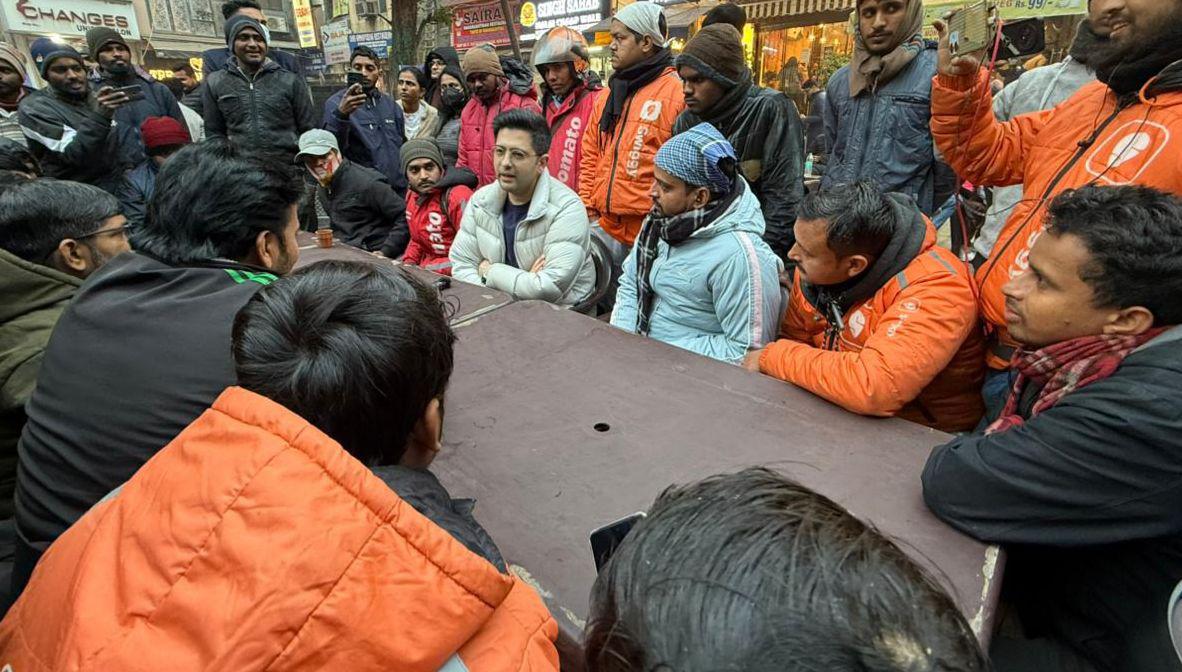
When delivery partners across India went on strike demanding fair pay, safety, social security, and predictable rules, the response from some platform companies was deeply troubling. Instead of engaging with legitimate labour concerns, protesting workers were branded “miscreants”, and their demands reframed as a law-and-order problem. This is not merely insulting—it is dangerous.
Workers asking for dignity are not criminals. And if a business model requires police deployment on its most important day to function, that is not proof of efficiency. It is proof of fragility. A system that needs coercion to survive is not a market success—it is a moral failure. Delivery partners are not employees on such days; they are hostages with helmets.
Let us be clear. Supporting workers’ rights does not make one anti-business. India needs its startups, entrepreneurs, and risk-takers. Innovation and enterprise are central to national growth. But there is a critical distinction between being pro-industry and being pro-exploitation. Growth that squeezes the last ounce out of the people doing the most challenging work is not sustainable progress—it is extraction disguised as innovation.
It is telling that the moment labour demands threaten margins or valuations, they are dismissed as “political agendas.” Fair pay is suddenly political. Safety becomes disruption. Accountability is labelled as an obstruction. This reflex says more about corporate insecurity than about workers’ intent.
A familiar defence is often offered: If the system were unfair, why do so many people work in it? History exposes the hollowness of this argument. Zamindari endured for centuries. Bonded labour persisted because people had no alternatives. Every exploitative system has justified itself by pointing to its own survival.
When a single day’s income decides rent, electricity, or a child’s school fee, logging in during a strike is not consent—it is compulsion. It is survival. Poverty does not signal approval; it signals a lack of choice. Nor can present injustice be justified by vague promises of a better future for workers’ children. Hope tomorrow cannot excuse hardship today.
High order volumes are not moral certificates. Lakhs of deliveries may impress investors, but they say nothing about dignity. Celebrating record numbers on a day known for higher payouts—while simultaneously crediting police action for “keeping things under control”—should give us pause. What exactly is being measured, and what is being ignored? A model that depends on pressure rather than trust is not resilient. It is brittle.
This debate is also about public safety. Incentive structures that reward speed and punish delay push delivery partners into dangerous behaviour. When we glorify ten-minute deliveries, we rarely ask who bears the risk when something goes wrong. Not just the rider, but pedestrians, families, and motorists share that danger. Efficiency that externalises risk onto the weakest participant is not efficiency at all.
Technology can optimise logistics, but it cannot replace transparency, protections, or due process. Today’s gig systems often hide pay behind opaque algorithms. Incentives change overnight without explanation. Workers are penalised for rain, traffic, and app crashes—factors beyond their control. Livelihoods can be switched off with a click, without hearing or appeal. This is not flexibility; it is unilateral control without accountability.
If individuals broke the law during protests, the law should take its course. But using isolated incidents to delegitimise an entire movement is dishonest. Branding workers as “miscreants” to silence demands for fair pay and dignity is not leadership. The answer to criticism is reform, not ridicule.
What followed the strike revealed another uncomfortable truth. Instead of reasoned engagement, a coordinated public-relations blitz unfolded. Identical talking points flooded social media. Influencers with no history of engaging with labour issues suddenly discovered concern. Board members found their voices online. Anyone familiar with public discourse can recognise a paid campaign when they see one.
Public relations firms were paid. Influencers were paid. Hashtags were purchased. The only people still waiting for fair payment were the workers delivering orders. When arguments ran out, attacks turned personal—on families, lifestyles, and motives. That is usually the moment when power realises it has run out of answers.
The focus should not be on individual lifestyles, but on improving the lives of gig workers. Those who have privilege also have responsibility. If one has a voice, one must use it to demand fairness for those without one.
This issue should not be polarised. The question is simple and unavoidable: will India’s growth be built on dignity and safety, or on pressure and insecurity?
India’s startups should scale. They should grow faster, compete globally, and innovate boldly. But they must not do so on the backs of people who keep their platforms running—order by order, kilometre by kilometre. Gig workers are the invisible wheels of the Indian economy. Platforms did not scale on code alone; they scaled on human labour.
Real progress is not measured by delivery speed. It is measured by whether the people who run the system can live with dignity. Fair and transparent pay. Safety and insurance. Social security. Predictable rules. And a grievance redressal system that offers real due process.
This is not agitation for its own sake. It is a demand for accountability. And it will not disappear until India decides that growth must carry human dignity at its core. Workers who built these platforms deserve better than to be criminalised for asking to be treated as human beings.