



Listen To This Post
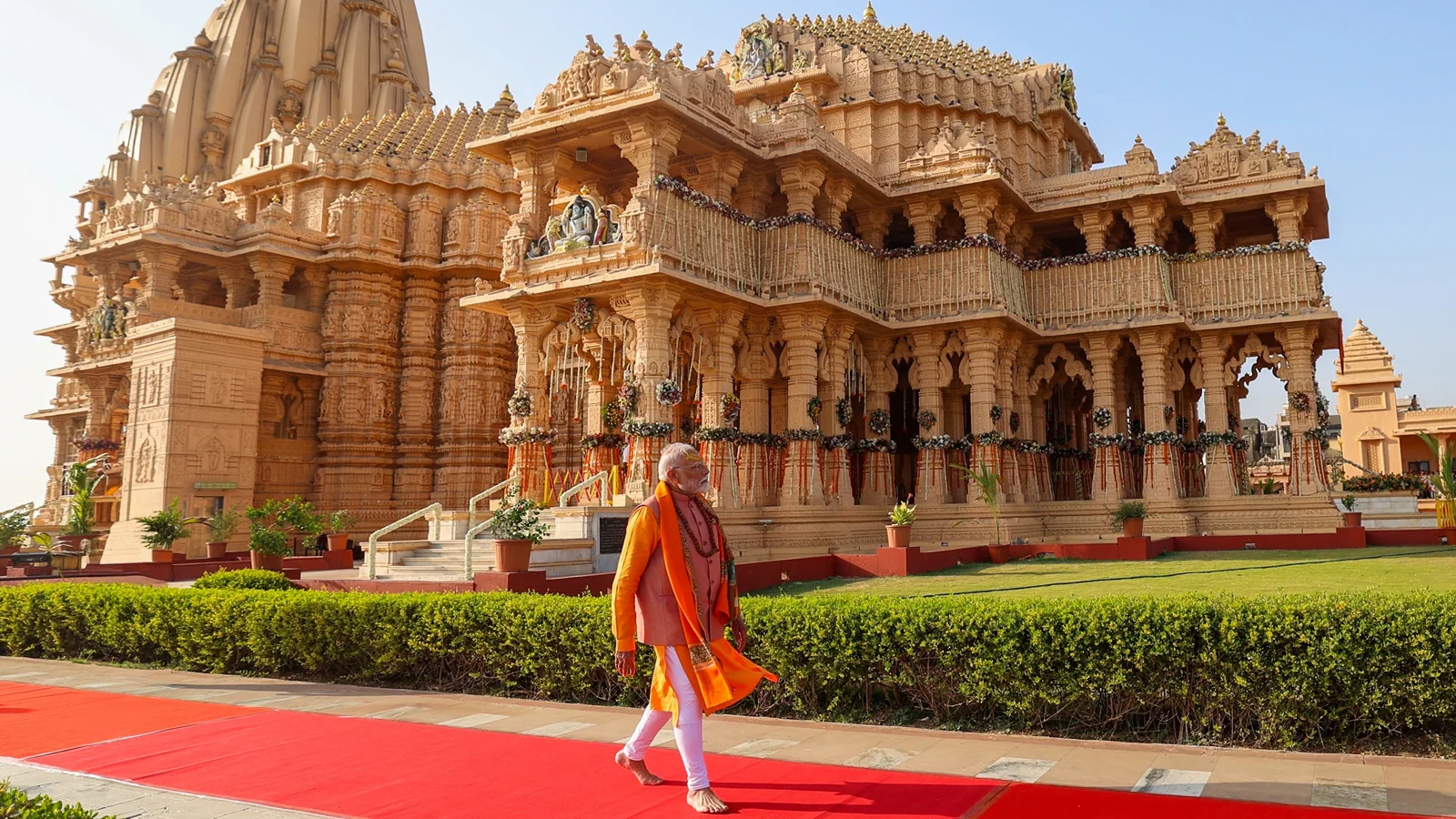
Gir Somnath (Gujarat): Prime Minister Narendra Modi on Sunday led the ‘Shaurya Yatra’, a ceremonial procession organised to honour those who laid down their lives defending the Somnath Temple in Gujarat’s Gir Somnath district. The event formed a key part of the Somnath Swabhiman Parv, commemorating 1,000 years since the 1026 invasion of the temple by Mahmud of Ghazni.
The Prime Minister also offered prayers at the historic shrine, underscoring Somnath’s enduring symbolism of faith, resilience and reconstruction. The yatra—spanning about a kilometre from Shankh Circle to Veer Hamirji Gohil Circle—featured a striking procession of 108 horses, representing valour and sacrifice.
Addressing the gathering, Modi noted that 1,000 students had conducted 72 hours of continuous ‘Omkar’ chanting as part of the observances. “Somnath’s history is not one of destruction and defeat, but of victory and rebuilding,” he said. “This thousand-year struggle has no parallel in world history. From Ghazni to Aurangzeb, religious fundamentalists believed their swords had conquered Somnath. They are now pages of history; Somnath still stands tall.”
Thousands of devotees lined the route, greeting the Prime Minister as he stood on a specially designed vehicle alongside Gujarat Chief Minister Bhupendra Patel. Young priests—Rushi Kumars—walked alongside, playing the damru, while cultural troupes from across India, including Jammu and Kashmir, performed traditional dances at intervals along the route.
At Veer Hamirji Gohil Circle, Modi offered floral tributes to Hamirji Gohil, the warrior who sacrificed his life defending the temple against the Delhi Sultanate’s army in 1299 AD. He also paid homage to Vallabhbhai Patel, whose intervention after Independence led to the restoration and reopening of Somnath to devotees in 1951.
The Prime Minister concluded the visit with a puja at the temple, sitting amid Vedic chants led by the chief priest—an act that, organisers said, symbolised continuity between remembrance, renewal and faith at one of India’s most revered shrines.