


Listen To This Post


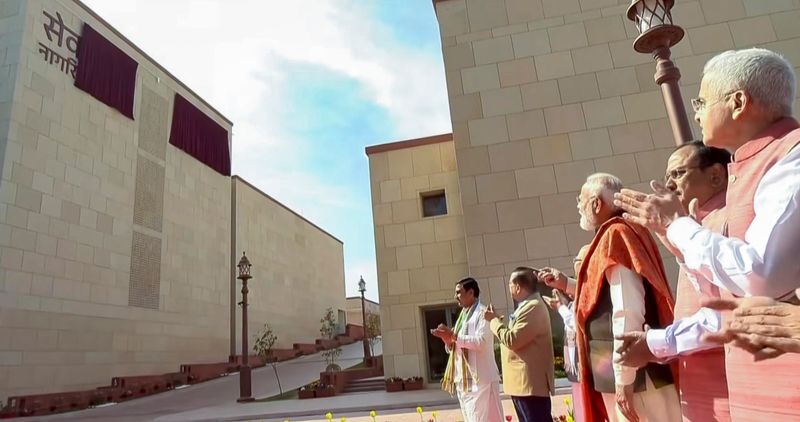
New Delhi: In a symbolic and policy-packed start from his new office complex, Narendra Modi on Friday signed four major decisions aimed at farmers, women, youth and vulnerable citizens, shortly after relocating the Prime Minister’s Office (PMO) to its new premises named Seva Teerth.
The decisions — described by officials as “service-oriented” — include cashless medical treatment of up to ₹1.5 lakh for accident victims, doubling the Agriculture Infrastructure Fund to ₹2 lakh crore, expanding the Lakhpati Didi initiative to 6 crore beneficiaries, and launching Startup India Fund of Funds 2.0 with a ₹10,000 crore corpus.
The Prime Minister had earlier chaired his final Cabinet meeting at the historic South Block, which the government vacated after nearly a century of functioning from the iconic complex. He later unveiled the name of the new PMO building as Seva Teerth and signed the files marking the first policy decisions from the new office.
Rs 1.5 Lakh Cashless Treatment Under PM Rahat Scheme
Among the key approvals was the launch of the PM Rahat Scheme, under which accident victims will be entitled to cashless treatment of up to ₹1.5 lakh.
The scheme aims to ensure that no life is lost due to delays in emergency medical intervention caused by financial constraints. Officials said the initiative is designed to strengthen immediate trauma care response and reduce out-of-pocket expenditure for families during critical hours following road or other accidents.
Lakhpati Didi Target Doubled to 6 Crore
In a significant push towards women’s economic empowerment, the Prime Minister approved doubling the target under the Lakhpati Didi initiative to 6 crore women.
Government sources said the landmark target of 3 crore “Lakhpati Didis” — women earning at least ₹1 lakh annually through self-help groups and livelihood initiatives — has already been achieved more than a year ahead of the March 2027 deadline.
With the revised goal, the government now aims to create 6 crore Lakhpati Didis by March 2029, effectively doubling both the scale and ambition of the programme. The initiative focuses on skilling, financial inclusion, entrepreneurship and market linkages for women, particularly in rural areas.
Agriculture Infrastructure Fund Doubled to ₹2 Lakh Crore.
In what officials described as a major boost to the farming community, the Prime Minister approved the doubling of the Agriculture Infrastructure Fund (AIF) from ₹1 lakh crore to ₹2 lakh crore.
The move is intended to strengthen the agricultural value chain by expanding investments in post-harvest infrastructure, such as warehouses, cold storage, processing units, and logistics networks. The increased expenditure is expected to support farmer-producer organisations (FPOs), cooperatives, startups, and agri-entrepreneurs, thereby improving farmgate realisations and reducing wastage.
Officials said the decision reflects a long-term approach to agricultural reforms focused on infrastructure creation and value addition rather than just input subsidies.
Startup India Fund of Funds 2.0 with ₹10,000 Crore Corpus
The fourth file cleared by the Prime Minister relates to the Startup India Fund of Funds 2.0, which will have a corpus of ₹10,000 crore.
According to PMO sources, the fund is aimed at catalysing the next wave of innovation, especially in deep tech, advanced manufacturing, breakthrough technologies and early-stage startups. The initiative seeks to provide growth capital to venture funds that, in turn, invest in emerging Indian startups, thereby strengthening the country’s innovation ecosystem.
Officials described the move as part of a broader strategy to position India as a global hub for cutting-edge technologies and high-value manufacturing.
A Symbolic Shift
The signing of the files from Seva Teerth carries symbolic weight, marking a transition from the colonial-era South Block to the new office complex. The PMO said the first decisions reflect a “spirit of Seva” (service) and are designed to touch every section of society — from farmers and women to youth and accident victims.
With these approvals, the government has signalled that the shift to the new PMO complex is not merely architectural, but also policy-driven — anchored in welfare expansion, infrastructure strengthening and innovation-led growth.