



Listen To This Post
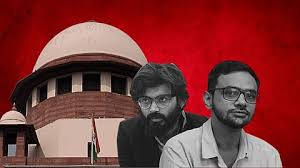
New Delhi: Former JNU student leader Umar Khalid, an accused in the larger conspiracy case linked to the 2020 Delhi riots, has approached the Supreme Court of India seeking a review of its January 5 order that denied him bail.
Senior advocate Kapil Sibal on Monday filed a review petition before a Bench led by Justice Aravind Kumar, requesting that the matter be heard in open court rather than through the usual in-chamber procedure.
Request for Open Court Hearing
Sibal urged the Bench to consider listing the review petition for a public hearing, stating that the matter warranted broader judicial consideration. The court, however, responded cautiously, noting that it would first examine the papers before deciding whether an open court hearing was necessary.
Typically, review petitions in the Supreme Court are decided through “hearing by circulation”, where judges consider written submissions in chambers without oral arguments. Only in exceptional cases does the court permit an open hearing.
Background of the Case
Khalid has been booked under the stringent Unlawful Activities (Prevention) Act, 1967 (UAPA), along with provisions of the Indian Penal Code, for his alleged role in the conspiracy behind the February 2020 Delhi riots.
The violence, which coincided with the visit of then US President Donald Trump, left 53 people dead and over 700 injured, and was triggered during protests against the Citizenship Amendment Act (CAA) and the proposed National Register of Citizens (NRC).
Khalid was arrested on September 13, 2020, with the prosecution alleging that he delivered provocative speeches on February 24–25, 2020, and played a key role in mobilising protests.
Supreme Court’s Earlier Stand
In its January 5 judgment, the apex court had rejected bail pleas of both Umar Khalid and co-accused Sharjeel Imam, citing a prima facie “central and formative role” in the alleged conspiracy.
The Bench had observed that the material on record suggested involvement at the level of planning, mobilisation, and strategic direction, going beyond isolated or localised acts. It held that the stringent bail threshold under Section 43D(5) of UAPA was applicable in their case.
At the same time, the court granted bail to five other accused—Gulfisha Fatima, Meera Haider, Shifa Ur Rehman, Md Saleem Khan, and Shadab Ahmed—stating that their roles appeared subsidiary or facilitative.
Other Developments in the Case
Earlier, activists Devangana Kalita and Natasha Narwal had secured bail from the Delhi High Court in September 2020, while bail pleas of other accused remain pending before the Supreme Court.
Khalid and Imam have now spent over five years in custody, making the review petition a significant legal development in one of the most closely watched cases related to the Delhi riots.
What Lies Ahead
The Supreme Court’s decision on whether to entertain the review in open court could shape the next phase of proceedings. If admitted for a detailed hearing, it may reopen judicial scrutiny of the evidence and the interpretation of the UAPA provisions in the case. For now, the Bench has indicated it will first examine the petition before deciding the course of action, leaving the matter poised at a crucial legal juncture.