


Listen To This Post
Prime Minister pitches new BJP chief as youth voice, stresses coordination within NDA
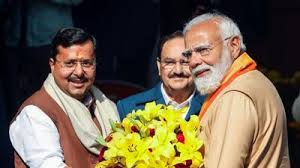
New Delhi: Prime Minister Narendra Modi on Tuesday struck a personal and political note while welcoming newly elected BJP president Nitin Nabin, describing him as his “boss” and identifying infiltration and urban naxalism as the two biggest challenges confronting the country in the coming years.
Speaking at a ceremony marking the transition of party leadership from J. P. Nadda to a younger president, Modi said his own political milestones were secondary to his identity as a party worker. “You will think Modi is a third-term Prime Minister, became Chief Minister at 50, has been in government for 25 years—but all these things are secondary. My greatest pride is that I am a BJP worker, and Nitin Nabin ji is my boss,” Modi said, drawing applause from the audience.
Addressing a gathering of BJP chief ministers, senior leaders and organisational functionaries, the Prime Minister described Nabin as a leader best placed to articulate the aspirations of the youth. Calling him a “millennial in spirit”, Modi said the new party chief had witnessed both the era of radio and the age of artificial intelligence, combining youthful energy with strong organisational skills.
Referring to 2026, which marks 75 years of the Jana Sangh—the ideological precursor of the BJP—Modi said Nabin’s leadership would be crucial at a defining moment for the party. He added that the new president would shoulder twin responsibilities: managing the world’s largest political party and ensuring effective coordination among National Democratic Alliance (NDA) partners.
Infiltration, urban naxalism top threats
While recounting key decisions of his 11-year tenure, including the abrogation of Article 370 in Jammu and Kashmir and the criminalisation of triple talaq, Modi said the focus must now shift to emerging challenges.
“The biggest challenge ahead is demographic imbalance and infiltration,” he said, reiterating that India would not tolerate illegal immigrants. Drawing global parallels, the Prime Minister noted that even the world’s richest nations deport illegal immigrants without their democratic credentials being questioned.
“No nation allows infiltrators to snatch the rights of its poor and youth. They are a serious threat to national security. It is essential to identify and deport them,” Modi asserted.
In a veiled attack on the Indian National Congress and INDIA bloc parties, including the Trinamool Congress, Modi accused certain political formations of protecting infiltrators for vote-bank considerations, saying the BJP would expose such politics.
The Prime Minister also described urban naxalism as another major challenge, alleging that its influence was widespread but that the country had now “seen through” attempts to brand the BJP as untouchable.
BJP’s electoral expansion
Earlier in his address, Modi thanked former BJP presidents for nurturing the party and adhering to its ideological course despite challenges. He said the BJP had, over the past 11 years, formed governments on its own in states such as Haryana, Assam, Tripura and Odisha.
Expressing confidence about the party’s prospects in Kerala in 2026, Modi spoke of the BJP’s expanding electoral footprint across the country. He said the party had emerged as a strong voice in states like West Bengal and Telangana and had defied the usual trend of anti-incumbency in Gujarat, Madhya Pradesh, Maharashtra and Bihar.
Highlighting recent local body election performances, the Prime Minister said the BJP’s “strike rate” had been extraordinary, citing Maharashtra where the party emerged as the largest force in 25 of 29 municipal corporations. He also pointed to Kerala, noting that the BJP now holds 100 wards and had gained control of the Thiruvananthapuram municipal corporation after 45 years.
Concluding his remarks, Modi said the BJP was defined not merely by leadership positions but by values and processes. “In our party, presidents change but not values; leaderships change but not direction,” he said, adding that the BJP’s strength lay in deep local roots combined with a national outlook—an approach that continues to draw people towards the party.