





Listen To This Post
WHO, NICPR and global public health experts warn that over 90% of smokeless tobacco users live in South-East Asia
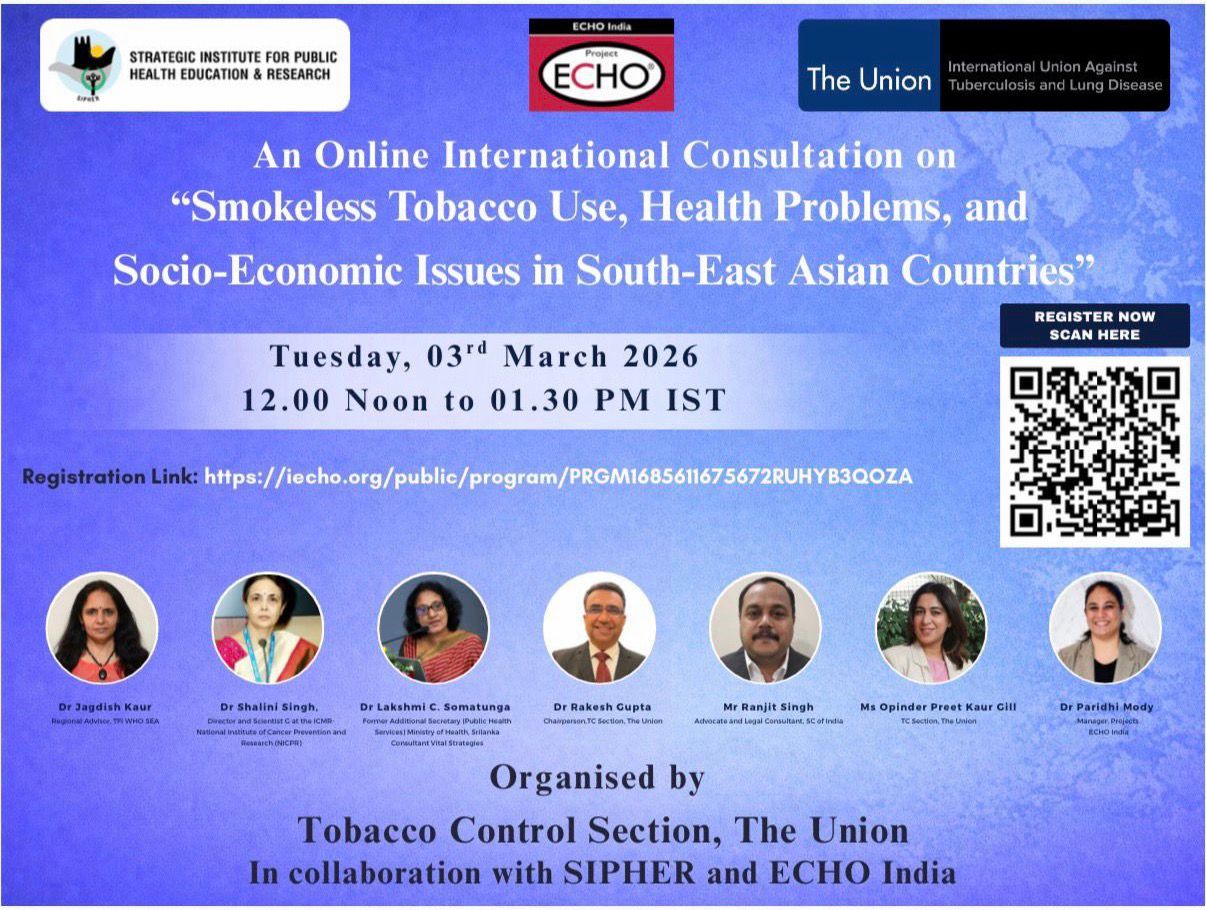
Chandigarh: Public health experts and policymakers from across the region on Monday called for stronger regulation and awareness campaigns against smokeless tobacco (SLT) during an international consultation held in Chandigarh on the theme “Smokeless Tobacco Use, Health Problems, and Socio-Economic Issues in South-East Asian Countries.”
The consultation was organised by the Tobacco Control Section of The Union in collaboration with SIPHER and ECHO India. Experts from the World Health Organisation South-East Asia Regional Office, the National Institute for Prevention of Cancer and Research (NICPR), and other public health institutions participated in the discussion. Dr Paridhi Mody of ECHO India hosted the consultation and moderated the interactive session.
South-East Asia at the Centre of Smokeless Tobacco Burden
Welcoming the participants, Dr Rakesh Gupta, President of SIPHER and Chairperson of the Tobacco Control Section of The Union, said that smokeless tobacco use remains deeply entrenched in South-East Asia.
He noted that over 90 per cent of global smokeless tobacco users live in this region, largely due to cultural acceptance, easy availability, low cost and widespread misconceptions that smokeless tobacco is safer than smoking. “Traditional products such as paan and gutka have contributed to the widespread use of smokeless tobacco in many countries of the region,” he said.
Health and Development Concerns Highlighted
Providing an overview of the issue, Ms Opinder Kaur from the Tobacco Control Section of The Union explained that smokeless tobacco refers to tobacco products that are not burnt but are instead consumed orally or nasally. Common forms include chewing tobacco, snuff or dip, snus and dissolvable tobacco products.
Dr Lakshmi C. Somatung, former Additional Secretary for Public Health Services in Sri Lanka and consultant with Vital Strategies, highlighted the broader impact of smokeless tobacco on public health and development. She noted that the use of smokeless tobacco has significant implications for achieving the Sustainable Development Goals (SDGs), particularly those related to health and socio-economic development.
Experts Stress Stronger Legal Enforcement
Legal expert Ranjit Singh, Advocate and Legal Consultant at the Supreme Court of India, spoke on the legal framework governing smokeless tobacco products in India. He urged state governments to issue notifications under Clause 2.3.4 of the Food Safety and Standards Regulations, 2011, to prevent the use of flavouring agents and additives in chewing tobacco products and ensure strict enforcement of existing tobacco control laws.
Countering Tobacco Industry Narratives
Dr Shalini Singh, Director of NICPR, discussed how the tobacco industry often uses economic arguments to oppose public health regulations. Drawing examples from Africa, she said the industry frequently claims that tobacco control measures will lead to job losses, reduced tax revenues and increased illicit trade — narratives that public health experts must actively counter with evidence.
Call for Uniform Regulation of Smokeless Tobacco
Delivering the concluding remarks as the chief guest, Dr Jagdish Kaur, Regional Advisor for the Tobacco Free Initiative at WHO South-East Asia, emphasised that smokeless tobacco should be regulated on par with cigarettes and other tobacco products.
She recommended mandatory health warnings on packaging, stronger public awareness campaigns, training for healthcare professionals on tobacco cessation and expanded support services for smokeless tobacco users seeking to quit.
Experts at the consultation agreed that comprehensive regulation, public education and stronger enforcement of existing laws are essential to curb the growing health burden caused by smokeless tobacco across South-East Asia.