


Listen To This Post
Chandigarh: The ruling Aam Aadmi Party (AAP) registered a resounding victory in Punjab’s civic body elections, establishing its dominance across urban Punjab and delivering a significant political message ahead of the Assembly elections due later this year. With counting largely completed by Friday evening, AAP had won 925 wards and was leading in several others, leaving the Congress, Shiromani Akali Dal (SAD) and Bharatiya Janata Party (BJP) trailing far behind.
The elections were held for eight Municipal Corporations, 75 Municipal Councils, and 19 Nagar Panchayats across the state, with more than 21 lakh voters exercising their franchise. The fate of 7,554 candidates was decided in what is being viewed as the final major electoral test before the upcoming Assembly polls.
By 7.30 pm, results for 1,908 wards had been declared. AAP emerged as the clear frontrunner with 925 victories, while Congress managed 372 seats. Independent candidates secured 248 wards, outperforming SAD, which won 189 seats. BJP finished with 167 wards, while BSP opened its account with seven victories.
| Party | Wards Won |
|---|---|
| AAP | 925 |
| Congress | 372 |
| Independents | 248 |
| SAD | 189 |
| BJP | 167 |
| BSP | 7 |
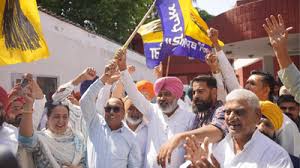
The scale of AAP’s victory triggered celebrations across Punjab. Party workers distributed sweets, danced to the beats of dhols and hailed the verdict as an endorsement of Chief Minister Bhagwant Mann’s government.
Senior AAP leader Manish Sisodia described the results as a decisive rejection of what he termed the BJP’s “ED politics”.
“People of Punjab have replied to the ED party. The politics of intimidation and central agencies will not work in Punjab. The people have once again reposed faith in Arvind Kejriwal and Bhagwant Mann,” Sisodia said, claiming that as many as 1,142 BJP candidates had forfeited their security deposits.
AAP dominates the Chief Minister’s stronghold
One of the most emphatic victories came from Chief Minister Bhagwant Mann’s Assembly constituency of Dhuri, where AAP won 20 of the 21 wards, underlining the party’s continued popularity in the Chief Minister’s home turf.
Mohali emerges as an AAP fortress.
The politically crucial Mohali Municipal Corporation also tilted heavily in favour of the ruling party. Out of 42 declared wards, AAP secured 24 seats, Congress won 9, while BJP, SAD, and Independents won 3 seats each.
Although AAP fell just two seats short of a simple majority in the 50-member corporation, it emerged as the single largest party and is expected to retain control of the civic body.
One of the most dramatic contests was witnessed in Ward No. 47, where AAP candidate Parminder Kaur won by a solitary vote.
In another high-profile contest, former Health Minister Balbir Singh Sidhu’s son Kanwarbir Singh Ruby suffered a surprise defeat at the hands of Independent candidate Paramjit Singh Kahlon from Ward No. 10.
The race for the Mayor’s post is expected to centre around AAP leaders Sunny Singh Ahluwalia and Sarabjeet Singh Samana, son of Mohali MLA Kulwant Singh.
AAP sweeps Zirakpur-Dera Bassi-Lalru belt
AAP delivered another strong performance in the rapidly expanding Zirakpur-Dera Bassi urban belt.
In Zirakpur Municipal Council, AAP won 12 seats, followed by BJP with 4, Congress with 3, SAD with 2, and 1 Independent.
In Lalru Municipal Council, AAP secured 11 wards, while Congress managed two seats and BJP, SAD and Independents won one each. The result was particularly significant as it pushed SAD, traditionally influential in the region under former MLA NK Sharma, to the political margins.
BJP shines in Nayagaon, Fazilka
While AAP dominated most urban centres, BJP managed notable successes in select pockets.
In Nayagaon Municipal Council, the BJP won a commanding 16 wards, leaving AAP and Congress with just one seat each and Independents with three. Ward No. 6 witnessed one of the closest contests, with BJP’s Surinder Kumar winning by only 10 votes.
In Fazilka Municipal Council, BJP emerged as the single largest party with 11 seats in the 25-member body. Congress secured nine seats, while AAP won five. SAD failed to open its account, resulting in a hung municipal council.
Patiala district strongly backs AAP.
The ruling party also performed exceptionally well in the Patiala district.
In the Patran Municipal Council, AAP secured a clear majority, winning 10 of the 17 seats.
In Samana, the party won 13 of 21 wards, comfortably crossing the majority mark.
In Nabha, AAP emerged as the largest party with 11 seats in the 23-member council, falling just one short of a majority.
Mixed results in Ropar district
The picture in the Ropar district was more varied.
AAP won a majority in the Ropar Municipal Council by securing 12 of the 21 wards.
In the Anandpur Sahib Municipal Council, the party registered a landslide victory by winning 11 of the 13 wards.
However, Congress retained its traditional strength in Chamkaur Sahib and Morinda. Chamkaur Sahib saw Congress win seven wards to AAP’s three, while Congress secured 10 wards in Morinda. Former Chief Minister Charanjit Singh Channi’s influence was evident in these results.
Nangal Municipal Council produced a hung house, with Congress winning eight wards, AAP seven, BJP three and one Independent candidate emerging victorious. Minor clashes between Congress and AAP workers were reported outside the counting centre.
Majitha, Doraha and other councils favour AAP.
AAP secured seven seats in the Majitha Municipal Council, against six won by the SAD.
In Doraha, AAP won eight of the fifteen wards. Local MLA Manwinder Singh Giaspura termed the outcome a “victory of the common man” and credited the result to the government’s development-oriented governance.
Opposition faces difficult questions.
While Congress managed isolated successes in parts of Doaba and eastern Punjab, the party largely failed to convert anti-incumbency expectations into electoral gains.
The Akali Dal’s performance remained disappointing in many traditional strongholds, while the BJP’s influence remained confined to a handful of urban pockets despite its aggressive campaign.
The large number of Independent winners—248 across the state—also underlined the continuing importance of local factors and personal influence in civic elections.
Political significance beyond municipal governance
Though local body elections are traditionally considered favourable terrain for ruling parties, the scale of AAP’s victory carries broader political significance. The results are likely to boost the confidence of Chief Minister Bhagwant Mann and AAP national leadership ahead of the Assembly elections.
For the opposition, especially Congress and SAD, the verdict serves as a warning that they face an uphill battle in challenging AAP’s dominance. BJP’s isolated successes may encourage, but the party still appears some distance away from becoming a major electoral force in Punjab.
With the Assembly elections now only months away, the civic poll verdict has strengthened AAP’s claim that it remains the principal political force in Punjab and the party to beat in the next electoral contest.