





Listen To This Post
Written by HARISH MANAV/ THE NEWS DOSE.COM
CHANDIGARH: In a dramatic political development that could significantly alter the balance in the Rajya Sabha, a group of seven Aam Aadmi Party (AAP) MPs on Friday announced their resignations from the party and their merger with the Bharatiya Janata Party (BJP).
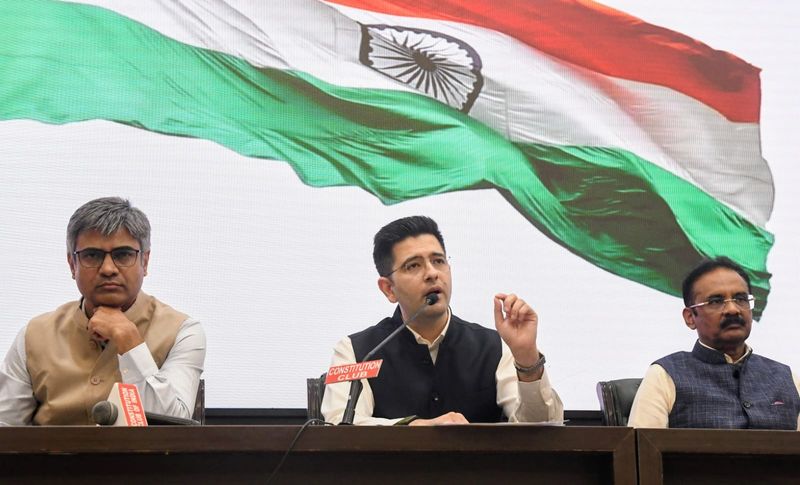
The leaders—Raghav Chadha, Sandeep Pathak and Ashok Mittal—announced at a press conference in New Delhi, stating that they had formally submitted merger documents to the Rajya Sabha Secretariat.
Chadha, emerging as the face of the group, claimed that two-thirds of AAP’s Rajya Sabha strength had broken away, asserting that the move was both ideological and political. “I was the right man in the wrong party,” he said, indicating deep internal dissatisfaction.
Seven MPs Cross Over to BJP
Alongside the three leaders, Chadha revealed that four other prominent MPs—Harbhajan Singh, Rajinder Gupta, Vikram Sahney and Swati Maliwal—were also part of the breakaway faction.
With this, the total number of MPs shifting allegiance rises to seven, marking one of the largest coordinated defections from AAP since its formation. The group announced that they would now function as part of the BJP bloc in Parliament.
Backdrop of Tensions and Agency Action
The political shift comes amid rising tensions within AAP, particularly in Punjab, where internal rifts and leadership disputes have surfaced in recent weeks. Notably, the Enforcement Directorate (ED) raids on premises linked to Ashok Mittal earlier this month had already triggered a political storm, with the party alleging that the central government was using pressure tactics.
Earlier in the day, AAP’s Punjab unit had accused the BJP of attempting to engineer a split by creating an “atmosphere of fear” through investigative agencies. Party spokesperson Baltej Pannu went a step further, alleging that Chadha was being “used as a tool” in a larger political strategy to weaken the party in Punjab. He also claimed that inducements, including a possible ministerial berth at the Centre, were offered to facilitate the defection—an allegation not acknowledged by the breakaway leaders.
Implications for AAP and National Politics
The exit of seven MPs deals a serious blow to AAP’s parliamentary presence, especially in the Upper House, where it had been steadily expanding its footprint. It also signals a potential realignment ahead of upcoming political contests, particularly in Punjab and Delhi. In the Punjab assembly elections, the polls are due in February next year.
For the BJP, the development strengthens its numbers and influence in the Rajya Sabha while simultaneously weakening a key Opposition player. For AAP, however, the episode underscores growing internal fissures and raises questions about leadership cohesion at a critical juncture.
As the dust settles, the immediate focus will be on how the Rajya Sabha Secretariat processes the merger request and whether the move withstands legal and procedural scrutiny. But politically, the message is already loud and clear—AAP is facing one of its biggest internal ruptures, and the ripple effects are likely to reshape the Opposition landscape in the months ahead.